Hello and welcome to Two Drams A Day. I haven’t paired any whiskies in a while, but I’m still discovering new single malts nearly every day! In the past, I’ve written an article on whisky at a duty-free shop and, more importantly, how to pick one. Today, I want to talk about whisky, which you may be able to find on your local supermarket shelves. Now, I live in London, and admittedly, my selection may be slightly better. This particular snapshot is of the offerings from Waitrose. But fear not! If you follow along, you should be able to deduce which whisky you should buy and why. So, let’s crack on! But first, we need music! Now playing: my top songs of 2016, which Spotify made for me eight years ago! A lovely memory!
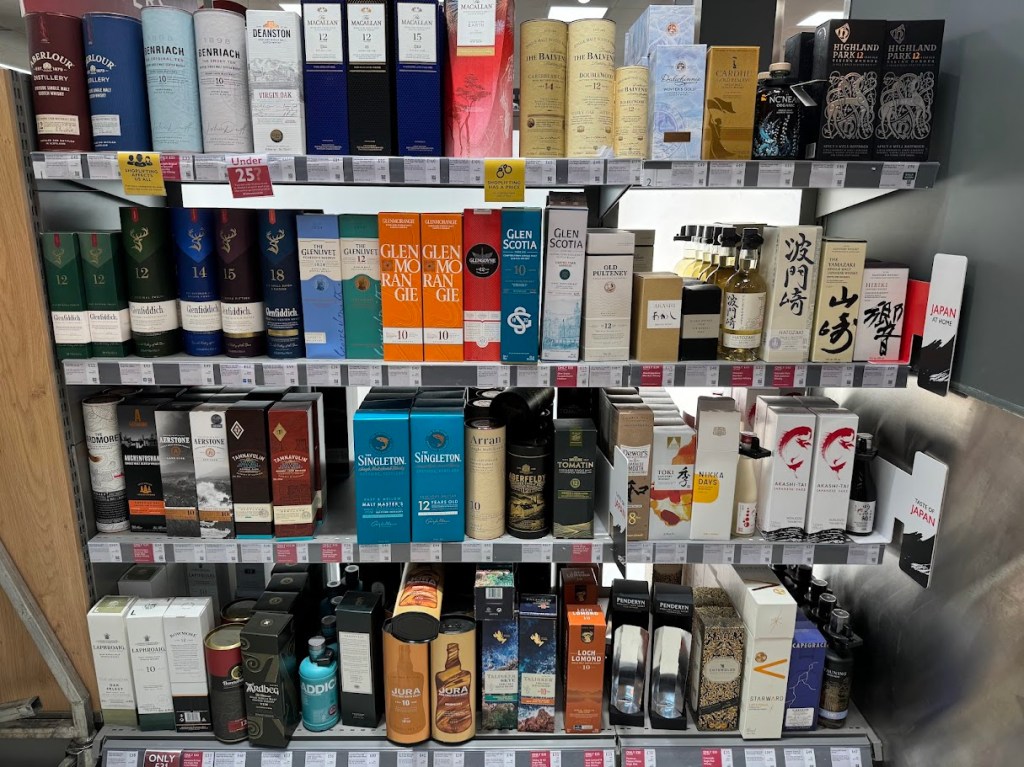
So here’s a pretty nice shelf of empty boxes (Waitrose is serious about shoplifting – apparently, it’s a thing here with booze). These even appear to be somewhat sorted alphabetically, and even with a bit of a regional section dedicated to Japan! Let’s start at the top and go one shelf at a time. We begin with Aberlour’s 12-year-old Double Cask and a 14-year-old, which are nothing special at 40% ABV. Then we have Benriach‘s The Original Ten and The Smoky Ten. I haven’t had those two, to be honest, but again, at 43% ABV, we’re moving right along. Deanston is something that I generally like but be warned that the Virgin Oak is slightly woodsy. I have reviewed it here and given it an integrity rating because it’s uncoloured and non-chill filtered! Next, The Macallan proudly displays their 12-year-old Double Cask and 12-year-old Sherry Oak Cask, followed by the 15-year-old Double Cask, but at 40% and 43% ABV, respectively, and those prices, these seem to be a rip-off. If you really must have The Macallan in your bar (to impress your friends, presumably), you can get it cheaper on Amazon. If so, I recommend buying the Sherry Oak and passing on the second maturation (to me, it just means that the first cask wasn’t up to par). Let’s walk right past A Night On Earth, or whatever that new marketing abomination without an age statement is at a stupid price. You must be buying just the packaging here! Let’s pause at The Balvenie – the 14-year-old Caribbean Cask could be a good buy, but it’s low on ABV, chill-filtered, coloured, and a little sweet. The DoubleWood is essentially a standard, and even at 40%, you can’t go wrong with it. I always have a bottle on my shelves. It’s like a baseline for my tastings! Dalwhinnie Winter’s Gold is another new ploy from Diageo, “intended to be served from the freezer“. What? Cardhu Gold Reserve is nothing special at all. Moving on… Nc’Nean, on the other hand, is worth pausing at – this is an uncoloured and non-chill filtered single malt bottled at 46% from a women-run distillery in Highlands. And yes, it’s also certified organic. If you haven’t tried it, I highly recommend that you do. And then we have Highland Park, which, although still a beloved distillery, is diluted down to 40%, which is a pass for me. I’d rather drink The Balvenie, but you may disagree. I finished the first shelf! The winner is Nc’Nean, followed by Deanston‘s Virgin Oak and The Balvenie‘s DoubleWood.
Well, that was certainly more than I intended to write for just a single shelf. Let’s waste no time and move on to the next one! We start on the left with the Glenfiddich. I used to love the 12-year-old and the 15-year-old, but as my palette evolved, I began to turn my nose up to 40% bottlings, as should already be apparent from the paragraph above. The 18-year-old is good, but once again, you’re mostly buying water there for 99 quid. It’s not worth it. I would say about the same for The Glenlivet (see this article where I compare both of them), and yes, about the same for the original Glenmorangie in its stupid orange packaging and the new ridiculous font. The Glengoyne 12-year-old is pretty good, and I would actually recommend it to anyone looking at The Macallan of the same age. Save yourself some money and try the Glengoyne instead! Now we come to Glen Scotia. I can tell you right now that the 10-year-old won a silver award from World Whiskies, and although it is diluted here down to 40%, it’s still an outstanding single malt. And you can’t go wrong with Campbeltown Harbour for only 25 pounds. Get any one of those instead of Old Pulteney 12-year-old. Suddenly, we’re in the Japanese regional whiskies. I’ve had the Akashi blended malt, and it’s nothing special. Neither is Nikka Whisky From The Barrel. I’ve never had the Hatozaki, and once you move past the cheaper blend, you may want to pause at that Small Batch bottled at 46% ABV [finally!]. I looked it up (just for you), and this one is uncoloured and non-chill-filtered integrity bottling. Thumbs up! The Yamazaki is definitely overpriced these days, especially that non-age-statement bottle and the Hibiki is also riding the coattails of the success of Japanese whiskies outside of its island. I would pass on those two as well, but my eye keeps coming back to that Hatozaki at only 43 quid. That’s cheaper than Nc’Nean up there! Okay, it’s time to call the winner, and I think the Hatozaki Small Batch wins this shelf (yes, I’m calling it without even tasting the whisky because it’s what I’d buy), followed by the Glen Scotia 10-year-old and then the Glengoyne 12-year-old.
Let’s move down to the third shelf. We’re halfway done, folks! First, we’ve got Ardmore Legacy. I’m a fan of this distillery, but I would only buy an integrity bottling. Then we have Auchentoshan American Oak. This is a cheap low-land single malt, and without an age statement and at 40%, we’ll pass it on again. Now, what’s this Aerstone? I have no idea. Let me look it up. Ah, it’s another cheap brand from William Grant, but it’s got an age statement of 10 years on it, and I’d be curious to try it. But not today. Next up is Tamnavulin, with its two NAS editions of Double Cask and Sherry Cask. The latter is only 23 quid! Is this the cheapest bottle we’ve seen so far? Why, yes! This one won a Gold medal from the International Spirits Challenge in 2020 under NAS single malts. I’d say that if you’re looking for an amazing deal, this could be it [so far!]. There’s an empty space where The Glenlivet Caribbean Reserve stood – I guess it’s all sold out. Next up is The Singleton from Dufftown. Same pattern as before – a NAS and a 12-year-old from Diageo. Both are at 40%, coloured and chill-filtered. No, thank you – the cask strength bottlings are good, though! Now, what do we have here – Arran 10-year-old has been in hiding! And boom! It’s an integrity bottling, with no colour or chill filtration, at 46% ABV. I absolutely love Arran, and at 43 quid, this is a no-brainer. Aberfeldy‘s 12-year-old is a pass, and Tomatin’s 12-year-old is a bit better, but it is still a “no” for me. Now, on to another strange Japanese whisky shelf, starting with Dewar‘s 8-year-old Japanese Smooth. Lol! What? That’s not Japanese! Skip. We now only have the Toki and Nikka Days. The latter is slightly better than Nikka from the Barrel on the shelf above, but not by much. However, once again, at 43 pounds, it’s overpriced for what you can find on this shelf. Instead, let’s talk about that, Arran, at the same price! For me, the choice is easy, once again, and I’ll call the Arran 10-year-old to be the winner of this shelf. If I had to choose the second and the third places, I’d pick the Ardmore and perhaps the Tamnavulin for its price point. Oh, and yes, I skipped the Akashi-Tai’s on the very right of the shelf because those are sakes.
We’re finally at the end, and is this truly a “bottom shelf whisky”? Let’s see what we can find. Starting on the bottom left, we have the Laphroaig Oak Select, which is a NAS, and for some reason, the 10-year-old is cheaper. If, like me, you ever had the Laphroaig 10 at cask strength, you can’t go back to this one, but it’s still an absolute staple. Now, we come to the Bowmore 12-year-old – another Islay distillery. Come to think of it, this is where all the peated whiskies are. Bottom shelf? We’ll move on to the Bunnahabhain 12-year-old, which, unlike the Bowmore, is bottled at 46.3% and is uncoloured and non-chill filtered. So that’s a win right there, folks. The cask strength edition of this stuff is absolutely sublime and is always on my shelves! Now, we’ve got the Ardbeg 10, which is an absolute banger at 46% and an integrity bottling! If you like your whisky smoky, you can’t go wrong with this one, folks! Right next to it is The Classic Laddie, which is at a smashing 50% ABV – the highest we’ve seen on these shelves so far, and its price reflects it. I absolutely love everything from The Bruichladdich distillery (especially the Staoisha!), but, unlike the Ardbeg, this one is unpeated. Then we have another classic, the Lagavulin 16-year-old, which is absolutely divine and is a favourite. But, once again, we’re back in the chill-filtered and diluted category, so keep that in mind. The Jura 10-year-old and the Bourbon Cask appear at a non-integral presentation – I love this distillery, but not at 40% ABV. Sorry. Then we move on to the Talisker Skye and 10-year-old, repeating the very same pattern of reduced quality. Here I compared Laphroaig 10 next to Talisker 10, and let me save you the time – neither took the prize. The Loch Lomond 10-year-old is an interesting and cheap offering, but you know already what I think. Next is the Penderyn Madeira Finish (I think), and this Welsh whisky is an integrity bottling, so two thumbs up! So is the English Cotswold Signature Single Malt. It may not be from Scotland, but it’s a great whisky from STR ex-red wine casks. The Starward Left Field is Australian and could have been presented better instead of its 40% bottom offering. I never had the Scapegrace Dimension, which is from New Zealand and is an integrity bottling at 46%. Ooh. I would love to try that! But I think I did have the Danish Stauning Host Whisky, but it was a bit unmemorable, to be honest. Whew! We’re finally finished! The winner for me here is the Ardbeg TEN, followed by the Bunnahabhain 12-year-old and then the Classic Laddie. I think you could have guessed that.
And, so, we’re done! Did you notice the overall pattern? Yes, the price is something to consider, but also, let’s not forget about the presentation. Do you want to pay less but drink more water? You can always add your own! What we want is an honest whisky. Sure, no cask strength at the supermarket, but we still can turn up the ABV volume to at least 46%. Let’s round up the winners from each shelf and see which one is the champion. Nc’Nean is okay at 55 quid. I actually had two pours of this stuff just last night and paid 16 per double. A little overpriced. Hatozaki is very interesting at 43 quid, but I’ve never had this, and it’s not a Scotch, so maybe put that to the side for a second. Arran is also at 43 quid and is already nudging further ahead of the first two (if not for the price alone), and finally, the Ardbeg TEN is just 10 pounds more. I just looked up both on Amazon, and Arran 10 is only 35 pounds there! What? Although I love my Ardbeg very much for this particular round, and to make my final overall recommendation, I will proclaim the Arran 10-year-old single malt as the absolute winner of this supermarket round! Yes, I’m pretty happy with that call. Grab yourself a bottle – you won’t be disappointed. I hope you have enjoyed this journey. Drop me a line with your thoughts below!
 Two Drams A Day
Oh how peoples buying practices differ! An entertaining exercise highlighting your preferences – which would be completely different to mine. In reality I’m trying not to buy more bottles – I’ve over 50 at present – but if pushed would only purchase something I’ve not had before or be unlikely to taste at a bar/show/friends house. This narrows the field down considerably. Smaller bottles always tempt too. I don’t obsess on presentation. A lightly peated blend at 40% with chill filtering & added caramel has pleased me more on blind tasting than a 46% Speyside single malt ncf & no caramel. With all that in mind nothing grabs me on the top shelf. I’d gravitate towards the Japanese on the next shelves – Hatazoki is the only one I haven’t tried – while Scrapgrace stands out on the bottom shelf. Its price however is above my self impose £50 limit so the prospect of flavoursome rye in Stauning looms. Meanwhile the exploration of new tastes & flavours with the Akashi Tai small bottles would probably win out on the day.