If you’re new here, welcome to Two Drams A Day! Each article is a personal journey where I pair two whiskies, often Scotch single malts among others, to discover the subtle differences that make each one unique and special. My approach is hands-on and intimate: I taste these whiskies side-by-side and share my real-time observations, from unexpected delights to the occasional letdowns. In the end, I choose a favourite, and along the way, I hope to learn something new and share that knowledge with you. If you’re curious about the nuanced and fascinating world of whisky and enjoy a personal touch in your reading, you’re in the right place. Stick around, subscribe, and join me on this flavorful adventure, two drams at a time!
Well, it’s January 2024, and I’m ready for the first entry in my side-by-side tasting. This will be a bit of a whacky one, and I’m pretty excited about it. You see, until now, I’ve been comparing Japanese whiskies to their fellow nationals, treating the Japanese whiskies as if they were in a category all of their own. But since the Japanese intend to stand up and, in some cases, surpass some of the world’s offerings, why not compare them as well? Today, I’ve got a single grain whisky from the Chita distillery [this is only the 5th dram from the Japanese Whisky Advent Calendar – I know, I’m way behind], which claims to only use corn in its distillate. So I’m curious to find out how it will stand up against the Mellow Corn from Heaven Hill, which I profiled about a year ago (wow, already?), next to another undisclosed “Corn Whisky” from TBWC here. Oh, and I had another new idea – starting in 2024, I will reveal my prediction because expectations can colour the experience. In this case, I think the Mellow Corn will win. So, let’s get to it, shall we? But first, you know that we need some music! Now playing: Sigur Rós – ÁTTA.

I used to really like the Chita from Suntory, but after some time that I spent delving deeper into the single malt territory, I found the single grain whiskies to be slightly rough. In Scotland, the single-grain bottlings tend to be much older, way above the 20-year mark, and often sold for a much lower price than their single-malt serious brothers. This is why you can find a 50-year-old bottle of single-grain whisky and pay under £500. But in Japan, they’re still pretty young. The Chita does not disclose its age, and thereby, it’s a NAS (Non-Age Statement) whisky. This is not exactly a great thing because there could be whiskies in there as young as three years old. It’s most likely a blend of various ages and casks, including wine and Spanish oak. But with a lack of transparency behind the process, I guess we’ll never know. It’s annoying, but okay, as long as we enjoy the whisk[e]y. This one is bottled at 43% ABV, and it’s probably coloured and also chill-filtered – so basically, the very opposite of the integrity bottling in every single way. The nose is light, and I can sense a bit of a hint of bourbon (because it’s also made from corn), but other than that, the grain-ness is there in its slightly rough, ethanol hit. The Mellow Corn is immediately sweeter and somewhat rounder on the nose, even at a higher ABV of 50%. The latter is a pretty cheap bottling of Straight Corn Whiskey (plastic yellow cap and all!) – this means that it has at least 80% corn in its mash bill. This one was also “bottled in bond”, which means that it was aged for at least four years and bottled at 100 Proof (50% ABV).
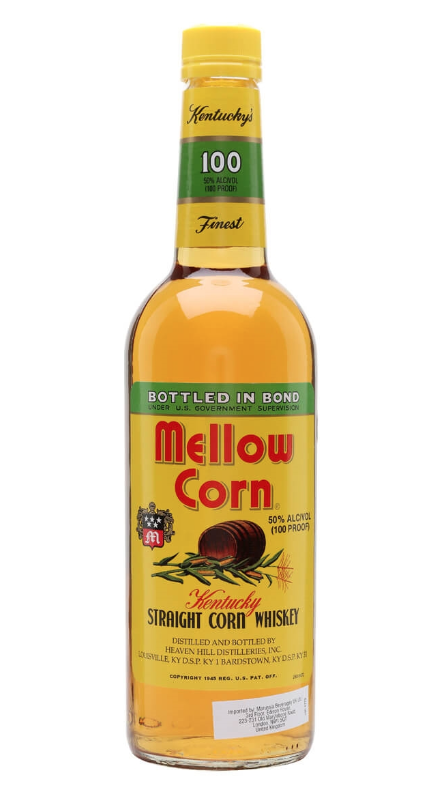
Let’s go in for a taste. First, the Chita. Yeah, it’s exactly how I remember it, and I can see this being slightly better as a highball if you’re into that type of thing. The Japanese definitely are. It’s got a slightly bitter aftertaste, which would be masked by the soda water and definitely that ethanol thing, which I’m not particularly a fan of. I can maybe sense some bourbon once again in there, and I can see the appeal of its very distant echo, but it is not as sweet as the bourbon itself. Speaking of which, let’s try that Mellow Corn now, first neat without water. Oh wow, it’s definitely stronger on the alcohol, but it’s absolutely smooth and thick and meaty – I almost don’t want to add any water to it, but let’s do it, even if it’s a drop to release all that flavour locked in by the alcohol. I’ll do the same with the Chita to even it out. And now the Chita is even more bitter, perhaps with the water or after the Mellow Corn, but nevertheless, this 43% Japanese whisky is sold at £57, while the 50% Mellow Corn is only £30-35! I’ll take one final sip of the Chita – yeah, it’s still a bit rough and now watered down. I think it would be best to compare it to other grain whiskies next time to see how it stands up. But next to the Mellow Corn, it’s crisp, very sharp and somewhat thin, with a very short finish. This could be a good thing if that’s what you’re after, but for me, at this moment, this straight corn whisky offers slightly more. I can see why Santory uses it in all its other blends, such as Hibiki (which also contains Yamazaki and Hakushu), Toki, Suntory Whisky Royal and Suntory Old Whisky. It’s definitely better than any single-grain that Diageo uses, that’s for sure, but not enough [for me] to drink alone.
| Distillery / Region | The Chita / Japan | Heaven Hill / Louisville, KY |
| Bottler | The House of Suntory | Distillery bottling |
| Stated Age | NAS | (Assumed at least 4 based on regulation) |
| Cask type | Unknown | Unknown |
| ABV / Cask Strength | 43.0% / No | 50% / No |
| Non-chill filtered/ Uncoloured | No / No | No / Yes? |
| Price | £57 | £35 |
| Did it win? / Did I like it? | No / No | Yes / Yes |
| Would I buy it? / Recommend it? | No / No, unless you’re into grain | Yes / Yes – what a prize! |
Well, there you have it, folks, another interesting tasting. Last time, the Mellow Corn did not exactly take the prize, but in another context, at another time, it definitely outshined its competition. Do you think it was a fair battle, or should I really stick to keeping the Japanese whiskies within their own continental constraints? Again, perhaps next time (if I will ever drink the Chita again), compare it next to Nikka Coffey Grain. Also, I think the price here was definitely a clear deterrent, even though I understand that the Japanese whiskies tend to simply fetch much more. I think that if the Chita wasn’t aged in any barrels at all, it would almost be considered Corn Vodka, as I suspect it was distilled at a higher ABV. With that said. I will pause here and proclaim the Mellow Corn as the winner of this round. And my prediction was correct!
 Two Drams A Day