About a year ago, I wrote an article on What Scotch Whisky to Buy at a Duty-Free Shop. It was specifically about London’s Heathrow Airport. I took a photo of the offerings and went over the individual bottles, nearly one by one. Recently, I found myself at an airport once again, and instead of providing a summary of what specific bottle to buy and the reason for my choices, I decided to share my entire thought process behind this with you. So what do you think? Let’s jump right in, but first, you know we need some music! Now playing: bvdub & Inquiri – Destroyesterday.
Before we go into the “how”, let’s quickly review the “why”. In most, if not all, international travel portals (by that, I also include train stations and sea ports), you may find a shop offering wares without the import tax (duty) or other taxes (like VAT or Sales Tax). This exemption from the local taxes allows some luxury products (including whiskies) to be sold at lower prices. That being said, the distilleries still pay Excise Tax on alcohol produced (and yes, that tax is somewhat baked into the final price and is then passed on to you, the consumer – you’re welcome). But don’t get easily swayed by the potential discount – do your calculations using the latest FX rate to ensure you’re getting something cheaper. Deals aside, this is not the only reason to shop at a duty-free shop. Many distilleries offer Travel Retail Exclusives – products which are designed to be sold only in these duty-free shops, presenting opportunities to pick up many limited editions, larger volumes, sometimes higher ABV contents, and unique themes aimed at both the novice consumer, as a way of brand exposure and introduction to their products (especially because of the better price point), as well as experienced whisky enthusiasts (and maybe collectors) as a way to provide an exclusive appeal. I don’t know why the latter works, but it does, and I often find myself searching for a particular bottle on a secondary market (like an auction) only because I want that special whisky again.

Enough about the reasons for this unique shopping opportunity. Let’s get into the weeds on how to proceed and pick out that one special bottle! Let’s start with step one: Don’t listen to anything that the sales rep tells you. They honestly do not know much about the whisky, often confusing the origin (mixing up Irish with Scottish!), the rarity, or the quality of the product. If you listen to them, everything is new, everything is a limited edition, and everything is an amazing, once-in-a-lifetime opportunity to pick up that rare gem! More than once, I got into a “friendly” argument with a rep, contradicting his knowledge of the presence of artificial colouring. I don’t know why I bother fighting with them – that’s really on me. Why should I expect a clerk at an airport to be an avid whisky expert? So, do yourself a favour and outright ignore their recommendations. Read the rest of this article instead! Second, even if you don’t agree with anything I say here, you may disregard it all, but see if you can try the whisky before you buy. Yes, some establishments (especially the ones that are stocked to the brim with Scotch) will give you a little sample. If there is a dedicated Macallan shop at the airport (like the one at Heathrow), be sure to ask to try the most expensive one – even at 8 am! What matters at the end is if you like the whisky and if you think it’s worth your dime. Yes, the craft and quality still matter, but if you still love Johnnie Walker, who am I to tell you that it’s just a notch above your window cleaner while the price for the brand name is hiked up. If you sip it and you like it, then you buy it. Now, let’s move on to the nitty and the gritty.
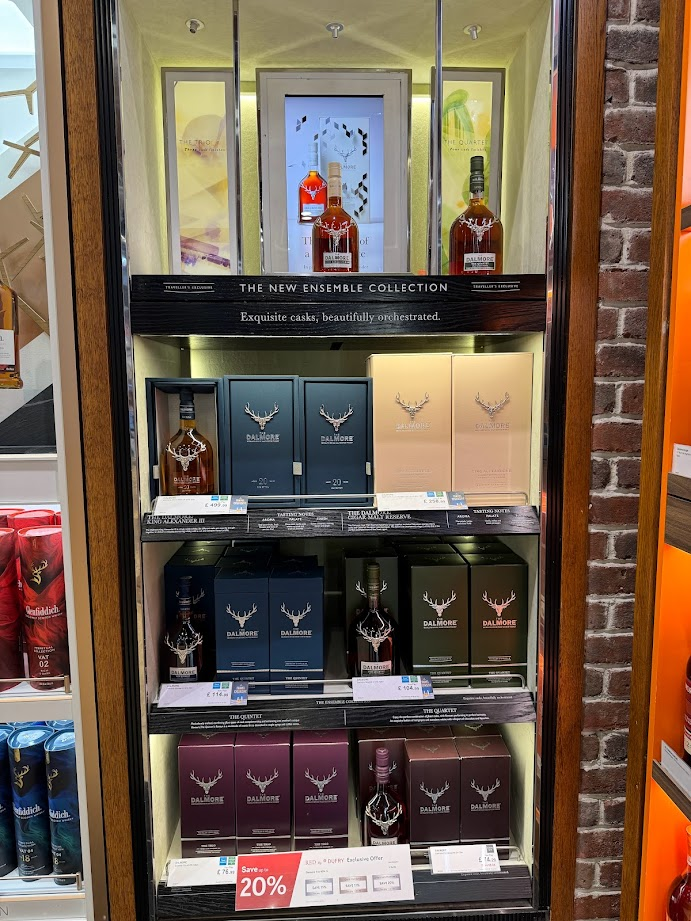
As mentioned, besides the favourable price, you may want to be on the lookout for those Travel Exclusive offerings. Some duty-free shops make it easy – at Heathrow, they have a little blue square next to each price tag (see the photos in this article), guiding you towards these exclusive editions. This way, you can skip the ones presented on the side and focus on something special that will keep your heart aglow. Sometimes, the distilleries will also write that on their label. And finally, maybe the sales rep can help. Although, again, I wouldn’t be that trusting. Third – or are we on the fourth point already? – you should try your best and ignore everything below about 46% ABV. That means you have to read the label on each bottle. Why? At 40%, you’re getting the bare minimum amount of alcohol legally required for it to be labelled a whisky. At 43%, often targeted at the American market, it gets a little better, but honestly, not by much. The real reason is the chill-filtration. In order for the whisky not to get cloudy, it must be filtered, especially if it is below the 46% mark. It doesn’t matter what the label says at this point – if it’s under 46%, it’s very much chill-filtered. The only rare exemption to the rule is a very old whisky bottled at “cask strength”. Its lower ABV may be due to evaporation over time from the barrel (you know this as the Angel’s Share). Single-cask whiskies bottled below 46% are usually over 25-30 years old (or something like that). The main point here is not the alcohol content but the act of reducing the quality of the product by chill filtering it. When you chill-filter your whisky, you remove all of those things that make it all the more delicious. For more on this particular point, you can scour the internet or do a blind taste yourself. And yes, look out for those bottles that explicitly say “no chill-filtration” or something in that realm.
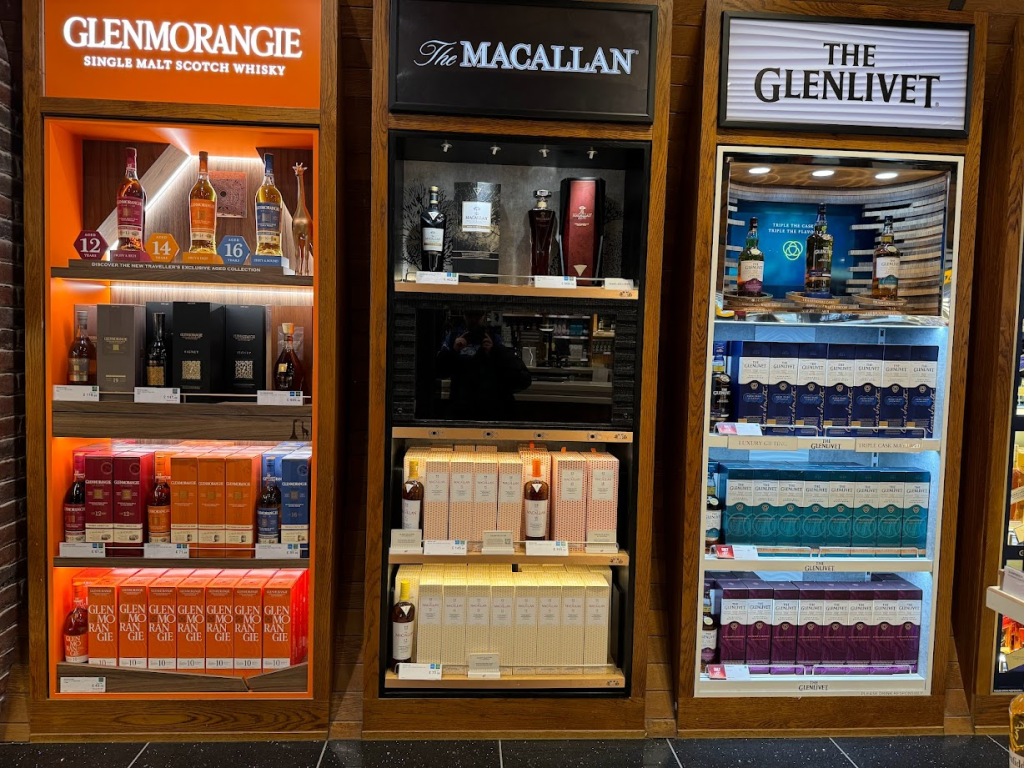
Right, the next thing, of course, is the added colouring. Take a look and ensure the bottle says something like “no artificial colouring” or “natural colour”. If it doesn’t say anything, it probably has colouring in it. Okay, it won’t really make the whisky taste any different, but I honestly just hate the unnecessary fabrication in the product that I buy. Why try to sell me something that is not exactly as it is, especially when so many other distilleries can provide an integrity product? Since becoming a bit more familiar with the process, I’ve even turned up my nose to many of my favourite brands after discovering the added colouring. Okay, I still enjoy their product, but it does feel slightly “less”, and if I have the opportunity, I always seek out an uncoloured whisky. I understand the reason for making a consistently “looking” product, but I still hate the lie. Next, let’s talk about the age statement. Of course, I cannot argue that since the older whiskies took much longer to produce, this investment is reflected in the price tag. But keep in mind, not all older whiskies are great (some really old ones start tasting like the oak barrel or wood shavings), and not all younger whiskies are bad (in fact, I prefer my Islay peated single malts to be below the 12-year-mark). The stated number means that the bottle’s youngest ingredient is of that age (there may be older whiskies in there). Conversely, a Non-Age Statement (NAS) whisky may have much younger blends than you would want, and that’s why the distillery does not disclose the number. Although it all comes down to the taste again, sometimes I have to pause and wag my finger at a few (I’m looking at you, NAS Mortlach Special Releases from 2022 at £250). So, pay attention once again, and truly ask yourself the reason for this veil. There are a lot of shortcuts in the bigger brands these days, and buyers should beware!

I’ve now covered the unique and limited edition series, the ABV, the colour and the chill-filtration – all of those attributes that make up an integrity bottling. With so much choice on the shelves, you should ask for nothing less. The price is now up to you! And usually, you’ll get what you will pay for. Although many major alcoholic beverage companies continue to hike the prices (Diageo, in particular, is pretty aggressive – Lagavulin 12 should not be over £150 [but I bought it anyway]), the market of the independent bottlers and smaller distilleries is thriving, and I urge you to explore its depths. I’ve included some pretty impressive whisky presentation photos in this write-up, and all you have to ask is, “Who is paying for this all?” The answer here, of course, is you. The bigger brands spend lots of dough on marketing campaigns – if only they gave back to the consumer! Alrighty then – I’ll pause here, hoping you have learned something today about this whole business of duty-free whisky shopping. Feel free to comment – don’t be shy – perhaps you’ll let me know what you have found in your local airport!
 Two Drams A Day