Welcome back to another fine tasting of two single malts, where I take notes in real-time as I compare them side-by-side to understand the differences, pick out a favourite, and hopefully learn something new along the way. I am slowly making my way through the Cask Explorer’s 2022 Advent Calendar (this one is the Emerald Edition), and today I am on dram #13, which is the anCnoc 12-year-old single malt that I decided to compare against The Balvenie DoubleWood of exactly the same age. And what is it about “twelve” that makes it a good number for whisky? Why not eleven or thirteen? I think it really doesn’t matter, as long as what’s inside the glass takes great. I’m ready to pop these two into my Glen Cairns, are you? But first, we need music! Now playing: Sophie Hutchings – A World Outside.
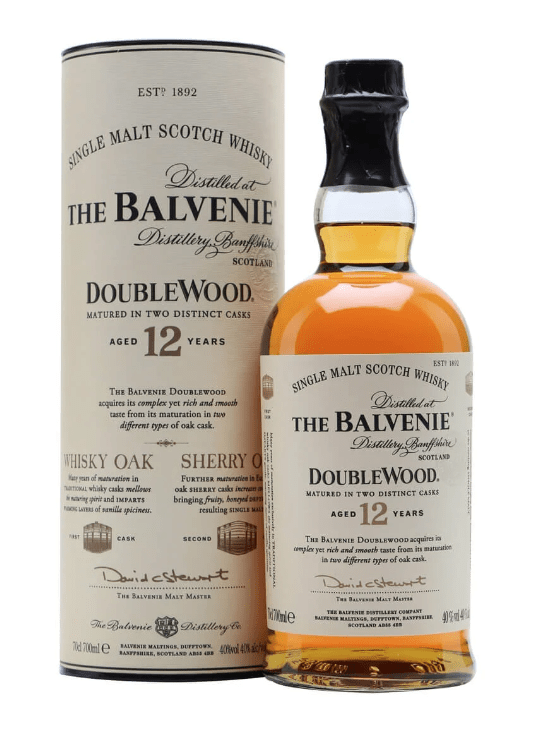
I start with The Balvenie DoubleWood. I’ve had this whisky many times before and covered it aplenty on these pages. The distillery is owned by William Grant & Sons, who also produce Glenfiddich, Kininvie, and Ailsa Bay, along with the Girvan grain distillery and Monkey Shoulder blended malt. The distillery grows its own barley and has its own malting floor, cooperage, and bottling facility. This means they have great control over their production process from start to finish. The DoubleWood starts its life in a white oak ex-bourbon cask, and then it is finished in an ex-sherry European oak cask for a shorter period of time for its signature “double wood” maturation. “Finished” here means the whisky is transferred from one barrel to another, often a different type, to gain additional flavours. This is a familiar dram, and I know exactly where I’m headed. Is it coloured? Yes. Chill-filtered? Yes. Diluted down to a minimum required 40%? ABV? Absolutely. And yet, somehow, it still brings back the memories of the first bottle I tasted. I haven’t been praising the DoubleWood in the last couple of years on here for all the right reasons – it’s not an integrity bottling, that’s for sure. But then, it is an entry-level single malt. If I want to have a genuine experience, I can just sip on the 12-year-old Single Barrel release, which is a whole other journey. That said, this particular dram is a benchmark in my toolbox for a whisky-tasting night. I know exactly where it starts, and I know exactly where it leads. So let me take a sip, and then we’ll move to anCnoc.

I’ve never tried the anCnoc single malt, and I’m actually pretty excited about tasting this Scotch for the very first time. It is produced by the Speyside Knockdhu distillery, which, in turn, is owned by Inver House Distillers, with Balblair, Balmenach, Pulteney and Speyburn in its arsenal. There is no “Knockdhu” whisky any longer, as the brand was renamed in 1994 to avoid confusion with Knockando. Now, all of its product is bottled under the name anCnoc, spelt with a lowercase ‘a’, which means “the hill” in Gaelic. The nose is much more complex on the anCnoc than on the Balvenie. The latter, albeit familiar, is flatter and dull, while the former is sharper and somehow more pronounced. Let’s go in for a taste. Oh wow, it’s pretty nice! It is slightly sweeter, but that sweetness is sharper on a particular frequency versus a broader spread out of consistent sweetness. It’s a confectionary caramel sweetness in a brighter, cleaner, wider plane. Let’s go back and forth now for a bit. The Balvenie is well incorporated, with a bit of welcome bitterness at the corners of my tongue. There is a bit of that ex-sherry from the second maturation. But the anCnoc is pleasant, with more bananas now caramelized in butter, some freshness, sherbert and zest. Here, I’m not saying it’s citrusy, but rather referring to the whisky’s bright and lively taste. Anyway, you know what? This is delicious! And I could see how this entry-level whisky, as an introduction to the brand, could get me to check out the rest of their offerings.
| Name | The Balvenie DoubleWood | anCnoc |
| Distillery / Region | Balvenie / Speyside | Knockdhu / Speyside |
| Producer | William Grant & Sons | Inver House Distillers |
| Bottler / Series | Distillery bottling / core range | Distillery bottling / core range |
| Stated Age / Vintage | 12 years old / n/a | 12 years old / n/a |
| Cask type | undisclosed | undisclosed |
| ABV / Cask Strength | 40.0% ABV / Nope | 40.0% ABV / Nope |
| Non-chill filtered/ Uncoloured | No / No | No / No |
| Price | £49.25 | £34.50 |
| Did it win? / Did I like it? | No / Yes | Yes / Yes |
| Would I buy it? / Recommend it? | Yes / Yes – it’s a must to have | Yes / Yes – under the radar |
So there you have it, folks, another fascinating tasting. I don’t know what I expected from anCnoc, but I didn’t expect it to be this good at such a low price point! It’s very tasty, with a flavourful profile and a pungent nose, which adds to the overall experience. It looks like the 18-year-old is actually an integrity bottling, uncoloured and non-chill filtered, bottled at 46.0% and sold for £100. That’s pretty good in this day and age. There’s also a Peated Sherry bottle, which I’d like to try, and a 24-year-old for £160 if you can find it. And with that said, I’ll pause here and proclaim the anCnoc 12-year-old as the winner of this round.
 Two Drams A Day