Welcome back to another fun tasting of two single malts, where I get to explore the minuscule differences between a carefully selected pairing when drinking them side-by-side, take down these notes in real-time as I sip on the whiskies, pick a winner, and hopefully learn something new along the way. Today, I’m pulling out dram #12 from the That Boutique-y Whisky Company (TBWC) Advent Calendar of 2022 [okay, there is no way I’ll finish all 24 before the year’s end], and it’s an exclusive release of 9-year-old Aultmore [meaning it’s not available as an individual bottle, yet]. And wouldn’t you know, I’ve never had Aultmore before, so this would be great to pair with something I know. And for that, I invite the Balvenie into the ring. I had a very similar successful pairing just a month ago here, so I’m pretty excited to see how I get on today. So let’s get to it, but first, we need music! Now playing: Clubroot – II – MMX.
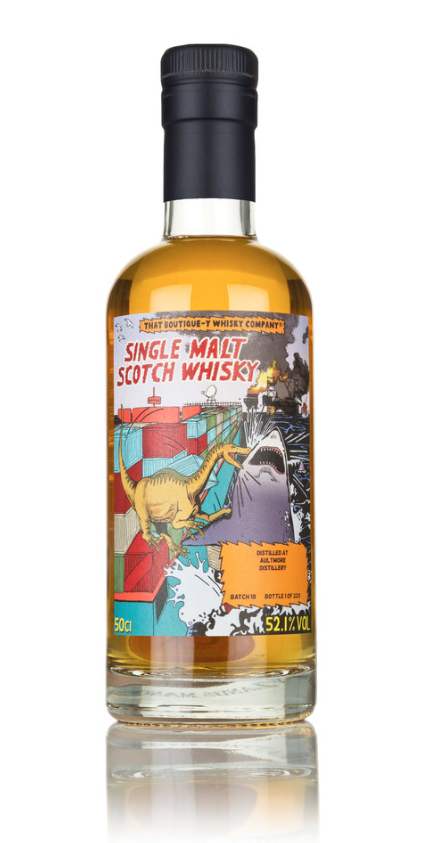
So, what do we know about Aultmore? Obviously, it’s not a very well-known distillery. Situated in Speyside near the town of Keith, it was founded in 1895 by Alexander Edward, who also owned Benrinnes. In 1923, it was bought by John Dewar, then switched hands again, then again, and as of 1998, it is part of Bacardi, which, to this day, uses its spirit in Dewar’s blended whiskies. As with all TBWC bottlings, this dram is non-chill filtered and un-coloured, immediately earning my integrity star in the profile stats. Non-chill filtering and the lack of colouring mean the whisky retains more of its original character and flavours. It’s a 9-year-old single malt bottled at 52.1%, and after my first sip neat, I’ll be sure to add a drop of water to see how it opens up. Let’s see what we get. It’s slightly waxy on the nose, with cereal, grass, and bright herbs. I sense no sweetness here, neither from ex-bourbon nor ex-sherry casks, so it probably spent its life in second or possibly even third-fill barrels. For context, the term ‘fill’ refers to how many times a cask has been used before. A first-fill cask was used once before, a second-fill twice, and so on. Each subsequent fill generally imparts less flavour to the whisky. Let’s go in for a taste. It’s light, sharp, and pretty even-tempered: not too sweet, bitter, and fruity. It’s somewhat mysterious, and I think it needs time. I’m curious about what happens after I taste my next dram. Let’s jump over to the Balvenie.
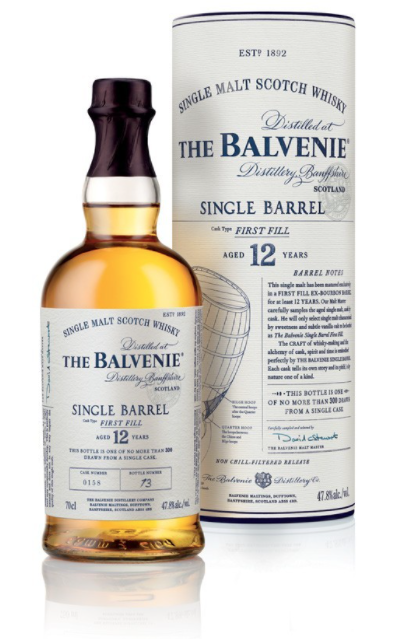
I’ve tasted this Balvenie before. As the name already revealed, this is a single barrel, bottled at 47.8%, and it’s also non-chill filtered. A ‘single barrel’ whisky means the bottle comes from an individual cask rather than a blend of various casks. This can make each bottle unique. One of my previous articles stated that it had added colouring. But I think I was wrong. My further research has confirmed that it is indeed uncoloured. It’s extremely light, almost like white wine, so the added colouring wouldn’t make sense. Thus, yes, it also gets my integrity star! It’s slightly sweet on the nose with that instantly recognisable profile but in undiluted form. I’ve tasted this a bit, I’ve added water, and now let’s dive deeper into both. Now, back to the Aultmore. It now opened up, and I could taste the cask influence. The entire flavour has that old-world profile with a slightly cardboard tint, which I kind of like. The Balvenie rounded off, but now it almost looks like water in my glass. It’s definitely sweeter than the Aultmore, but the character’s subdued. This Balvenie came from a first-fill ex-bourbon barrel, but it must have been very inactive, as it hasn’t impacted much of the whisky. Usually, when a whisky spends about twelve years in a first-fill ex-bourbon barrel, it extracts much flavour and colour during maturation.
| Distillery / Region | Aultmore / Speyside | The Balvenie / Speyside |
| Producer | John Dewar & Sons Ltd (Bacardi) | William Grant & Sons Ltd |
| Bottler / Series | TBWC / Advent 2022 Exclusive | Distillery bottling / Single Barrel |
| Stated Age | 9 years old | 12 years old |
| Cask type | Undisclosed | First fill ex-bourbon barrel |
| ABV / Cask Strength | 52.1% / don’t know | 47.8% / undisclosed |
| Non-chill filtered/ Uncoloured | Yes / Yes 🌟 | Yes / Yes 🌟 |
| Price | Not on the market | £60 |
| Did it win? / Did I like it? | Yes / Yes | No / Needs a revisit |
| Would I buy it? / Recommend it? | Can’t buy it / need to taste another | Yes / Yes |
So there you have it, folks, another fantastic pairing. I must admit, the profile on the Aultmore is slightly more interesting, and now I think it has some sherry in it. Neither of these has knocked my socks off, and for some reason, I feel slightly deflated after tasting the Balvenie – and I was such a big fan of this single malt! I may have to redo this tasting just for fun – I have a sample of Aultmore 15-year-old from 2006 bottled by Cadenhead’s, which is definitely a vatting of ex-bourbon and ex-oloroso sherry casks. But I also want to sip the Balvenie 12-year-old cask strength next to its core range DoubleWood and see how it stands out. For now, I will proclaim the Aultmore as the winner of this round!
[Update Oct/26/2023] I returned to that 15-year-old Aultmore by Cadenhead’s, and on this one, the cask influence is front and centre, and almost too much. Whereas the sherry is more pronounced here, so is the oak, and it’s not particularly pleasant. I’m not really getting the profile of the spirit here, so it’s not really fair to judge. The Balvenie, on the other hand, holds on to its sweet-honeyed flavour. I just wish it was more pronounced, as it still feels like a weaker cask.]
 Two Drams A Day