Well, hello there, and welcome back to another fine tasting of two single malts grains, where I sip them side by side to peel apart the tiny differences in profile, pick a favourite, and hopefully learn something new along the way. Won’t you join me in this fun adventure, and if you dig this, maybe you will stick around for more? For today’s bout, In the left corner, we’ve got a 22-year-old single-grain Scotch whisky from Loch Lomond distillery, bottled by Douglas McGibbon for their Clan Denny series. This one came from behind door number 9 of the Cask Explorer‘s 2022 Advent Calendar (Ruby Edition). In the right corner, I select the only single-grain Scotch whisky I have in my collection, a 26-year-old Cambus (a Diageo‘s workhorse) bottled by James Eadie. They are slightly different in age and very different in profile (more on that later), but it’s the best side-by-side pairing I could come up with today. So let’s get right to it, but first, we need music! Now playing: James Murray – Ascensión por Chimo Pérez.
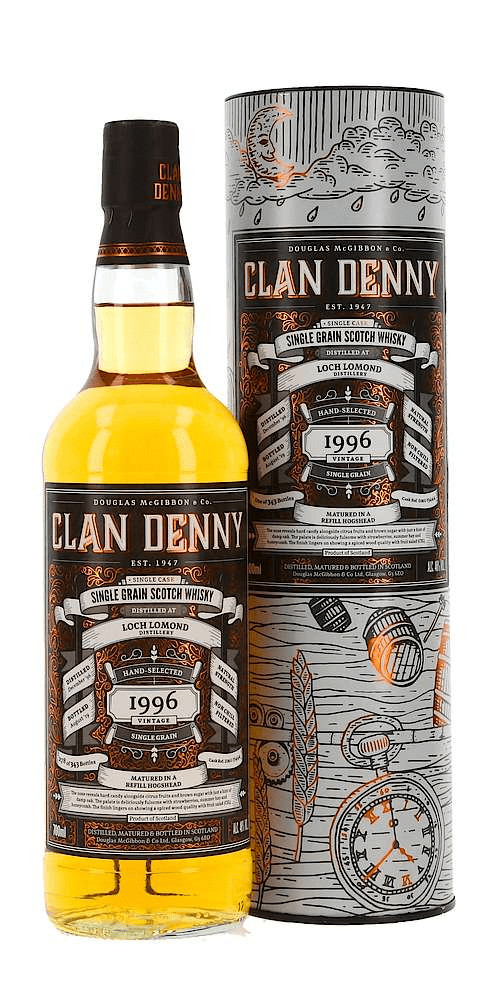
So both whiskies are in my Glencairn glasses now, and the colour is immediately different. Since both have no added colouring, the eye can tell the “truth” and confirm that Loch Lomond came from a refill hogshead while Cambus came from a sherry butt, where I believe both have spent the entirety of their lives, both being at cask strength and un-chill filtered. Interestingly. Loch Lomond is from 1996, and after 22 years has gone down in ABV to 48% (the label says it’s bottled at natural cask strength), while Cambus, bottled in the same year, but distilled in 1993, is holding up at 55.4%. That means Loch Lomond has given up much more of its share to the angels (I don’t believe this bottler would lie). Also, and this is the big question on my mind now, I know that Loch Lomond has column stills, and therefore, by definition, any grain distilled in those cannot be called a “single malt”. So it’s very possible for the grain to still be barley, but because of column stills, it must be labelled “single grain.” I crawled the web to find an answer, but alas, I cannot confirm. I guess I will find out in a second when I bring the glass up to my nose and lips. Let’s see now, does it smell like bourbon? Yes, it does, but that could also come from the cask. Let’s have a taste at 48%. Yes, there it is, at the very end, a hit of ethanol that could be traced back to a “well-aged-vodka”, but what’s the grain? I don’t think it is barley. Most likely corn. It is a little harsh for barley after 22 years of ageing. I’ll add a drop of water and let it stand a bit to open up.

Let’s go to Cambus now, neat. And it’s a sherry bomb, for sure. There’s also waxiness and a deep amber raisin glow. I cannot peel apart the grain or character of the distillate alone; it’s somewhat overshadowed by the sherry. I’ll add more water to this one to bring it down to comparable levels of Loch Lomond. Back to the Loch Lomond. The nose has changed. It’s slightly sweet and candied but is very thin. It doesn’t smell like bourbon any longer. Indeed, it feels like an aged vodka infused with ripe pears. It’s somewhat smoother on the palate, and now that bite of ethanol is gone, dissolving into a long and pleasant finish. More honeyed fruit and almost malt, not quite. Let’s try the Cambus now, and… damn, it took to water well, and although there is still some musk and funk, it’s almost like a nicely aged Macallan! The finish is a little bitter, like a cherry syrup-dipped cigar mixed with dark chocolate. But I am not complaining. At first, I felt that Loch Lomond was nicer in its tale, but now I cannot wait to reach out for the Cambus once again. I guess I am a sucker for that sherry. So just another drop of water and reverse the order, starting with the Cambus. The funk is either gone now, or my nose is used to it. It’s still bittersweet and soft and mellow all around. I wouldn’t be able to tell that it’s a single grain. I search my archives to see if I’ve reviewed this one before and find a write-up from October of 2022, and yeah, I’m pretty much consistent in my observations on the sweetness, funkiness and maltiness. Haha! One final sip of Loch Lomond. I know what this reminds me of! Japanese whisky! It’s kind of clean tasting [hence my numerous vodka references above], crisp, thin, and yet flavourful at once.
| Distillery / Style | Loch Lomond / Single grain | Cambus / Single grain |
| Bottler / Series | Douglas McGibbon / Clan Denny | James Eadie / Single Cask |
| Stated Age / Vintage | 22 years old / 1996 | 26 years old / 1993 |
| Cask type | Refill hogshead | Sherry butt |
| ABV / Cask Strength | 48.0 / Yes | 55.4% / Yes |
| Non-chill filtered/ Uncoloured | Yes / Yes 🌟 | Yes / Yes 🌟 |
| Price | £100 | £100 |
| Did it win? / Did I like it? | No / Yes, but has a distinct flavour | Yes / Yes – a great dessert single grain |
| Would I buy it? / Recommend it? | No / Not sure, to be honest. | Not any more / Yes |
Well, there you have it, folks, another excellent pairing. I did enjoy Loch Lomond, but as I said above, I’m not exactly reaching out for more here. I’ve tried this dram and feel that I will leave it there for now. Whereas the 26-year-old from Cambus keeps inviting me to take a sip. It’s simply delicious but just a little overcooked and overshadowed by the sherry. At least it’s not extremely oakey, and a bit of water [I just added even more] really lifts it up. So what have we learned today? I think a single grain from Scotland needs to age a little longer. I don’t know why that is. The distillation process? How come a bourbon can be smooth and less alcohol-intense at just three years old? The virgin toasted oak? I must research some more to understand the difference. For now, I will pause here and proclaim James Eadie‘s bottling of 26-year-old Cambus as the winner of this round.
 Two Drams A Day