And we’re back for another fine sampling of two whiskies where I get to peel apart the tiny differences by tasting them side-by-side. In keeping up with my recent journey across the Japanese offerings, and while the last few drams I’ve tasted are still fresh in my mind (see how Nikka Taketsuru Pure Malt goes up against The Nikka Tailored and Nikka Pure Malt Red), I decided to pair a sample of Nikka Days next to Nikka From The Barrel, and okay, I’ll sip a bit on Pure Malt on the side to see how it fits in. I purchased these 30ml bottles a few years ago as part of the Japanese sampling from Drinks by the Dram and have been waiting to pop them open. I kind of feel like they will show up once again in that Japanese Whisky Advent Calendar (2021) that I am going through. In any case, I’m still excited to compare. So let’s get to it, shall we? But first, we need music! Now playing: Rrose – Please Touch.
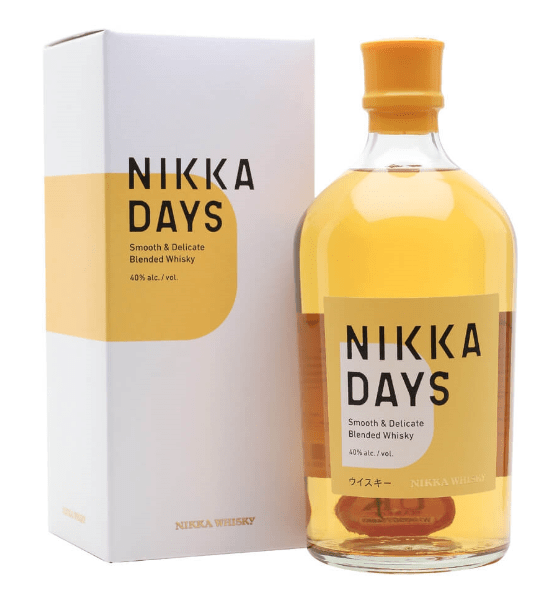
I’ve covered a bit of history behind the Nikka and its founder, Masataka Taketsuru, in the last few posts, so I will not repeat it here. If you’re interested in details, you can also read the story on the distillery’s site. So let’s jump in and start with Nikka Days and see exactly where it stands. Unlike the Taketsuru Pure Malt, which is a vatted blend of single malts, Nikka Days is a ‘blended whisky’. That means it contains some grain alcohol, most likely from corn. Bottled at a minimal 40% ABV, it’s the perfect entry point for whisky newbies. Nikka Days is chill-filtered, with added colouring, and the website also discloses that this product does not meet all the criteria of “Japanese whisky” as defined by the Japan Spirits & Liqueur Makers Association, which means that there is probably a whisky in this blend from another country. Since Nikka also owns the Ben Nevis distillery in Scotland, you can go ahead and draw your own conclusions while I’ll just take a little sip. Ignoring the colour, let’s go to the nose – it’s light and floral, and there is cereal and fresh fruit in the background. It’s pretty smooth on arrival, with a very distant hint of grain alcohol and rather honeyed sweetness, boiled apples, and a hint of barrel char. I take a moment to appreciate this flavour and move over to the Taketsuru Pure Malt. It is immediately slightly thicker and rounder, with a slightly higher ABV. Its sweetness is now more like caramel from that ex-bourbon barrel, which I barely can detect, while Nikka Days is more like a vanilla pudding, light and satin.

Now over to the Nikka From The Barrel. Guess what? Although it’s thankfully bottled at a nice 51.4%, maintaining all the flavour that I’m about to unlock, it’s still a blend, and it’s still coloured and chill-filtered (such a shame!). So why is it then titled “From The Barrel“? Well, unlike the other blended whiskies from the same distillery, after marrying “more than 100 different batches“, the blend is matured for another few months in “barrels” of unspecified type. This “harmonizes all components of the formula, resulting in a mellow taste“, or so the company’s website proclaims, right before it admits that this product also does not meet all the criteria of “Japanese whisky”. So, what’s in there? Let’s have a look. The aroma of Nikka From The Barrel is indeed more powerful than that of Nikka Days – again, this is attributed to the higher alcohol content that still has not released the flavour. Let’s have a sip first neat, and then I’ll add some water. That’s nice and crisp, with a very tiny bitterness of grain alcohol on the edges, a pretty medium-length finish that attempts to recall some stewed fruit, winter spice and oak. It’s got a punchier delivery than all the others, and now when I sip on Nikka Days, it’s almost artificial in its taste [it also feels a little watered down, but somehow rounder, mellower at that]. Let’s add some water to the Nikka From The Barrel and see how it decides to open up. It mellowed out just a bit, but its delivery is still triangular in flavour – by that, I mean it feels like there is a pyramid that I would draw to describe the profile, with a sharp peak at the top, mostly associated with grain whisky, which is completely smoothed out in Nikka Days. I’ll add even more water to see what happens next. Okay, it’s softer now but not as well integrated as the Taketsuru Pure Malt, and it feels like it was wrestled into submission. Do you know what I mean?
| Name / Style | Nikka Days / Japanese Blended Whisky | From The Barrel / Japanese Blended Whisky |
| Distillery / Region | Yoichi, Miyagikyo + ??? / Japan | Yoichi, Miyagikyo + ??? / Japan |
| Producer | Nikka | Nikka |
| Bottler / Series | Distillery bottling / core range | Distillery bottling / core range |
| Stated Age / Vintage | NAS | NAS |
| Cask type | Undisclosed | Undisclosed |
| ABV / Cask Strength | 40.0 / No | 51.4 / No |
| Non-chill filtered/ Uncoloured | No / No | No / No |
| Price | £41 for 70cl | £41 for 50cl |
| Did it win? / Did I like it? | Yes, but barely / Eh… | No / Not really |
| Would I buy it? / Recommend it? | No / No | No / No |
So there you have it, folks, another interesting tasting. If I had to be honest, I think I’d pick the Taketsuru Pure Malt from the mix. I think the grain is used here to bump up the content with more alcohol, but it breaks up all the flavour, which I find in Taketsureu Pure Malt. But this was meant to be a battle between Nikka Days and Nikka From The Barrel. So what about the price? At £41 for 70cl, we’re talking 0.58 cents per cl for Nikka Days, against the very same £41 but for 50cl, which makes it 0.82 cents per cl for Nikka From The Barrel. But let’s go a step further and calculate the cost per cl of pure alcohol. At 40%, there is only 28cl of pure alcohol in Nikka Days, which means you’re paying £1.46 per cl of alcohol. And at 51.4% in a 50cl bottle, there is 25.7cl of pure alcohol in Nikka From The Barrel, so you’re paying £1.59 per cl of alcohol for that pleasure. So now the difference is really 0.13 cents between them. Does that make sense? But what about the flavour overall? I take one last sip of the diluted Nikka From The Barrel and feel like now it tastes a lot like Johnnie Walker – bland and thin. With that, I will proclaim Nikka Days as the winner of this round. It’s just an easy “daily” drink.
Look a the colour difference between these two blended whiskies in the picture and then dismiss it entirely because it means absolutely nothing. Now search for the age statement, and when you can’t find it, think whatever you want. Now think about the fact that this whisky is from Japan and throw that away as well because we have no idea of the proportion of Ben Nevis in either of these blends. And finally, decide if what you’re drinking tastes good and is worth your money. I’ll leave it at that.
 Two Drams A Day