So yesterday, I popped open the 7th entry from That Boutique-y Whisky Company (TBWC) 2022 Advent Calendar, and it was a 5-year-old dram of Corn Whisky. Now, I usually compare two whiskies side-by-side here. But honestly, [at that point in time] I didn’t have a corn whisky in my personal collection. I also wasn’t sure about this type of whisky in general. I’ve heard some people call it “harsh” and “rough”, and the alcohol content [and the price] usually indicated some affirmation thereof. But when I tasted this unique specimen, I was indeed amazed [a-mazed – get it?] at what I found inside this bottle. So let’s get a quick overview of corn whisky and share this journey together! But first, you know that we need music! Now Playing: Marine Eyes – Idyll (extended edition).

So what is Corn Whisky anyway? Surely, the name “corn” implies the main ingredient. Whereas a Scotch malt whisky [by law from the UK Government inforced further by Scotch Whisky Association] must be produced from malted barley in copper stills, grain whisky could be made from malted and unmalted cereals [corn included], usually in continuous column stills. There is a slight occlusion here [the opposite of what one would call a “loophole”], and if malted barley is distilled in a continuous column still, it can’t be qualified as “malt whisky” and must be labelled “grain whisky”. I think that’s a disservice to that particular fine product, but that’s another story for another time. Now, American whiskey regulations are a little different. Specifically for bourbon, the mix of grains used in the production must consist of at least 51% corn. The rest could be anything: rye, wheat, malted barley, oats, and even quinoa. And if it’s not explicitly labelled “bourbon,” you may even be able to find 100% wheat whisk[e]y and [my favourite] 100% rye. But we are drinking corn today! This particular dram comes from an undisclosed distillery (meh!) [my label also says product of Canada], bottled un-coloured and un-chill filtered at 51.1% ABV, and I’m pretty sure that it was finished in ex-oloroso sherry casks [at least the description on Master of Malt mentions that]. It’s light and sweet and definitely sherried, with creamy red fruit, spices, and a surprisingly long finish. The label on this bottle shows the “Fun Police” crossing out the word “Rye” on the whiteboard, with some other words redacted in black. In the upper right corner, there is a hanging shirt with “I heart PG” on it, so that must be Prince George, in British Columbia. So who would distil corn in PG? Stillhead? CrossRoads? And does it really matter?
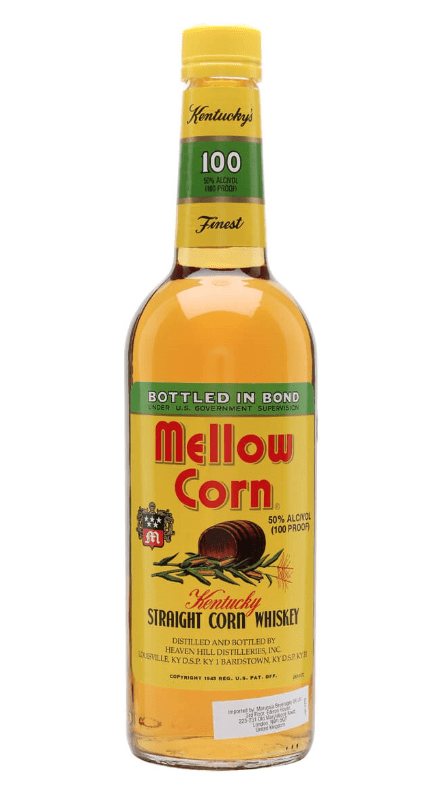
OK, I broke down and went out and bought myself a bottle of Mellow Corn. At only £32, it was an easy punt to take. Worst case scenario, I’d make myself some cocktails on the rocks. But what do you know? I enjoyed this whiskey very much! It wasn’t sherried like Corn Whisky, but it was still a light, smooth, and sweet pour that surprised me with its delivery [and alcohol content]. This one is distilled by Heaven Hill from Louisville, Kentucky [and hence the spelling of “whiskey” with a ‘y’ because it’s American], and uses a mashbill of a minimum of 81% corn, with the remainder being a combination of malted barley and rye, to kick off the fermentation process. I’ve seen this bottle in a pub but never dared to try it. The 50% alcohol content (“100 proof” by American standards) and its “bottom-shelf” price somewhat turned me away. But now I’m really liking all the flavours. This particular corn whiskey was “bottled in bond”, which means that the whiskey was produced according to specific legal requirements set forth in the US Bottled-in-Bond Act of 1897. The act was introduced to ensure the quality and authenticity of spirits during a time when adulteration and mislabeling were common practices. In particular, the whiskey must be produced by a single distillery during a single season, aged in a federally bonded warehouse for a minimum of 4 years, bottled at 100 proof, and have a clear indication of the above facts on the label. What’s not to like about this term now? As a result, “bottled in bond” spirits are considered to be of higher quality! And this product is as authentic as they come! It’s also a “straight corn whiskey” and was aged in new uncharred or used charred barrels – which is a very different requirement than it is for bourbon.
| Distillery / Region | Undisclosed / Canada? | Heaven Hill / Louisville, KY |
| Bottler | That Boutique-y Whisky Company | Distillery bottling |
| Stated Age | 5 years old | (Assumed at least 4 based on regulation) |
| Cask type | Unknown + ex-sherry finish | Unknown |
| ABV / Cask Strength | 51.1% / Yes? | 50% / No |
| Non-chill filtered/ Uncoloured | Yes / Yes 🌟 | No / Yes? |
| Price | £33 (for a 50cl bottle) | £35 |
| Did it win? / Did I like it? | Yes / Yes – very surprised | No / Yes – still loved it! |
| Would I buy it? / Recommend it? | Yes / Yes | Yes / Yes – easy to find – grab one! |
Well, there you have it, folks. I was going to cover just one corn whisk[e]y but ended up writing about both. They’re very different, I must say, but then again, what would you expect if these were Scotches? The most interesting point about Corn Whisky that I may share is that, unlike Bourbon, it has less regulation about the casks in which it must be aged. And as we know, the cask indeed imparts its flavour! So a corn whisk[e]y can be aged in re-fill, used casks, and even finished, as is the case this time, in ex-sherry barrels. And this opens up a whole new world of possibilities! I’m holding on to my now-opened bottle of Mellow Corn, but for this particular tasting, I must proclaim Corn Whisky #1, bottled by TBWC, as the winner of this round.
Note the various spellings of whisk[ey] in this write-up. In general, all Scotch, Canadian and Japanese product is “whisky”, and all American and Irish product is “whiskey”. The spelling variations reflect historical and linguistic influences that have shaped the way these words are used. The “e” in “whiskey” is thought to have originated in Ireland, possibly as a way to differentiate Irish whiskey from Scotch whisky at a time when Irish whiskey was considered superior in quality.
 Two Drams A Day