Welcome back to another great pairing of two single malts, where I spend the time peeling apart their intricate layers, choosing a favourite, and hopefully learning something new along the way. Why don’t you join me and follow along! Up for a face-off today are two interesting expressions from the Highlands of Scotland. We’ve got the luxurious Signet from Glenmorangie, and a 17-year-old whisky finished in Pinot Noir casks from Deanston. The latter came from my Cask Explorer’s 2023 Advent Calendar (Ruby Edition, door number 7), and the former was hanging out on my shelves with just enough spirit for a bottlekill. So let’s get to it, but first, we need music! Now Playing: The Album Leaf – Future Falling.
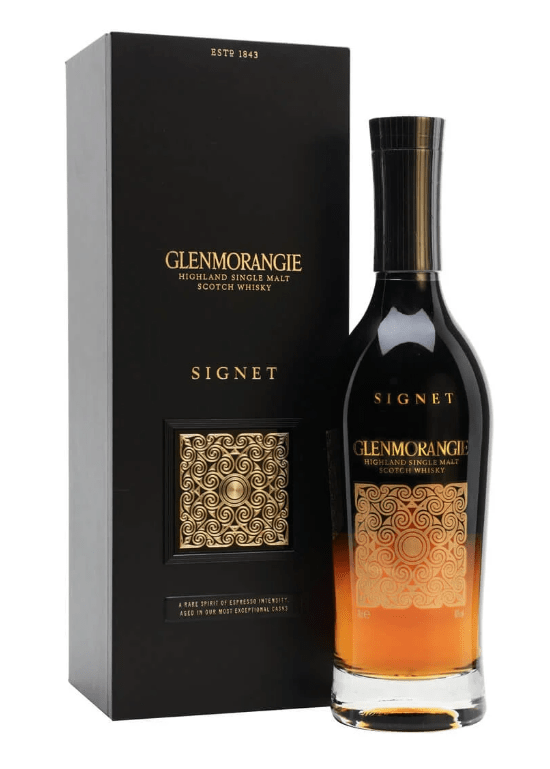
Let’s kick off with the Signet. I choose to start here because it’s bottled at a lower ABV of 46%, and is a chill-filtered [and coloured] whisky, so it’s probably lighter and thinner on the palate. From my experience, I prefer to build up the tasting rather than jumping off a cliff from integrity bottling down to a consumer-level single malt – at least it gives this whisky a bit of a chance to open with a prologue. Does that make sense? This is a non-age statement (NAS) spirit made from heavily-roasted malt, which, just like coffee beans, gives the whisky a bit of an “oomph” on the flavour profile. As expected, there is plenty of dark fruit on the nose, with cherries dipped in chocolate on top of warm velvet cake. It comes in with a nice smooth arrival with plenty of red fruit, a bit of orange peel and spice. Plenty of coffee and chocolate all around. There are definitely some older whiskies in here, with the youngest carrying the blend. The Scotch Whisky Association rules claim that if age is stated, it must be that of the youngest whisky in the bottle. So, even if there was a splash of a 21-year-old Glenmorangie in here mixed with a 5-year-old, the age statement would have to say “5”. And no one will be reaching out to spend upwards of £190 for a young whisky, now will they? And hence the Non-Age Statement on the label. It would have been nice to have more transparency here and have Glenmorangie break down the ingredients somewhere on its website. Instead, we are only told that “the final blend combines sweet whiskies extra-matured in ex-sherry casks, spicy and toasty whiskies from charred, new oak barrels, and whiskies from the oldest Glenmorangie stocks.“

The Deanston 2002, on the other hand, is an integrity bottling. The whisky is uncoloured, non-chill filtered, and bottled at a perfect 50% ABV. It even states the vintage year and lists the number of bottles in this limited edition run. We don’t know, however, how long it has matured in the ex-bourbon barrels and then the time it has spent in the Pinot Noir casks. But that’s still a lot more information than the secret recipe of the Signet, but let’s go in for a taste! As expected, it is thicker and denser on arrival. There is the regular ex-bourbon flavour, but now the fruit’s coming in. But it’s tasting a bit strange – like spoiled sour grape juice. I’ll add a bit of water to temper it down a bit and see what I can peel apart here. Aha! Sour cherries, that’s what it is! Sour cherries dipped in molten caramel ice cream. At first, I didn’t like it at all because it felt strange and unfamiliar – as if someone poured a whisky into a previously used wine glass. But now I think I’m getting accustomed to the flavour. Let’s take a pause and switch back to the Signet again. It’s definitely thinner, “darker”, and even bitter now after the Deanston. The finish is full of espresso notes, as it comes in hot, like from a cheap cardboard cup. Let me come back to the Deanston again and keep that cherry profile on my mind. There are Maraschino cherries floating in my whisky glass. It’s good because it tastes as if a sweet liquor was poured over my dessert. It’s bad because it’s not what I expect to taste in whisky. Instead, the dessert is offered by the Signet, like a bar of molten dark chocolate oozing down my coffee mug. I had certain expectations going into this, but somehow it was still a bit surprising all around.
| Distillery / Region | Glenmorangie / Highlands | Deanston / Highlands |
| Producer | Glenmorangie | Distell International |
| Bottler / Series | Distillery bottling / core range | Distillery bottling / limited edition |
| Stated Age / Vintage | NAS | 17 years old / 2002 vintage |
| Cask type | White oak + Oloroso finish | Ex-bourbon + Pinot Noir finish |
| ABV / Cask Strength | 46% / No | 50% / No |
| Non-chill filtered/ Uncoloured | No / No | Yes / Yes 🌟 |
| Price | £105 | £190 |
| Did it win? / Did I like it? | No / Maybe – will try again | Yes / Yes |
| Would I buy it? / Recommend it? | No / Yes, if you’re into cherry fruit | Maybe – expensive / Yes |
So there you have it, folks, another gripping tasting. I must admit, I’m definitely having a hard time picking a winner. On the one hand, the integrity bottling by Deanston hits all the right notes, while Signet feels a little veiled and definitely branded. There’s only one disclaimer I must make before I make a call – I’m not a fan of win casks for my whisky. I kept on trying, and in this case, I was almost there. But I prefer the sweeter, smokier, and darker notes versus the sour, super fruity, lighter flavours. Of course, my palate is completely different from yours, and I would hope that from these words, you’ll draw your own conclusions. Alas, I’ll pause here and proclaim the Signet as the winner of this round. It’s what I’d reach for if I wanted one more dram tonight.
[Note: I did not say anything about the Signet‘s absolutely gorgeous bottle, its satisfying hefty weighted cork, or the beautifully presented black box, which still remains on my shelves, even after I tossed the bottle out. So please, do not buy a bottle of whisky because of how it looks! Go try it in a bar first and see if you would like it.]
 Two Drams A Day