If you’re new here, welcome to Two Drams A Day! Each article is a personal journey where I pair two whiskies, often Scotch single malts among others, to discover the subtle differences that make each one unique and special. My approach is hands-on and intimate: I taste these whiskies side-by-side and share my real-time observations, from unexpected delights to the occasional letdowns. In the end, I choose a favourite, and along the way, I hope to learn something new and share that knowledge with you. If you’re curious about the nuanced and fascinating world of whisky and enjoy a personal touch in your reading, you’re in the right place. Stick around, subscribe, and join me on this flavorful adventure, two drams at a time!
Welcome back to another fine pairing of two single malts! Today is a great one, especially because I did not set it up in advance. I will admit that I didn’t have the two bottles in front of me, and I did not taste them side-by-side. What I did was go out and stop by a nice hotel bar for a drink before my dinner, and that’s where I saw The Macallan 18 Sherry Oak. And then, I went to another nice hotel bar for a second drink before my dinner, and that’s where I saw the other Macallan 18 Double Cask. And yes, although the setting, the process, and, therefore, the “tasting” are not exactly like all of the others I set up here, I still took notes to remember the outcome. So, won’t you join me for this roundup? But first, we need music! Now playing: James Murray – Soundflowers.
The Macallan distillery, founded in 1824, is a renowned producer of single malt Scotch whisky located in the Speyside region of Scotland. I have a bit of a love/hate relationship with The Macallan. Back when I had just started enjoying Scotch whisky, I used to always reach out for a bottle of its delicious, sherried, full-bodied, rich single malt across all of its age ranges. Somewhere around 2012, as the demand for its output [mostly from Southeast Asia] outreached its production capacity, the 18-year-old nearly disappeared from the shelves, and, as you can imagine, the prices skyrocketed. Suddenly, The Macallan turned into a “luxury brand” with a real premium, and I spent a lot of time searching for other distilleries that wouldn’t ruin my wallet. I did indeed find plenty and slowly began to turn up my nose to The Macallan. It was simply way overpriced, way over-marketed, and felt more like a collector’s whisky than a real connoisseur’s. However, once in a while, I would revisit this whisky. And every time I tried it, I would recall all the wonderful notes I had cherished before – it has a particular flavour of toffee and cloves with rich vanilla and, of course, that gorgeous sherry. There is just something about the selection of casks used to mature this nectar that kept me coming back. This is where I finally realized that if I wanted to continue and enjoy this experience, I’d simply have to pay a premium and shut the hell up. As far as I can tell, there is no ceiling for the price of The Macallan, and basically, I’m just telling you that if you like what you taste here, you better stock up. Let’s turn to the 18-year-old single malt now and first recognize the two distinct editions in this same-age release.
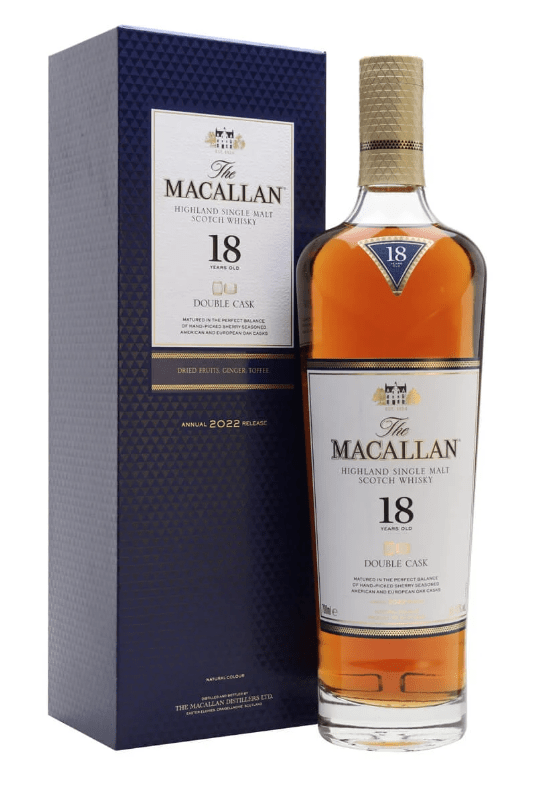
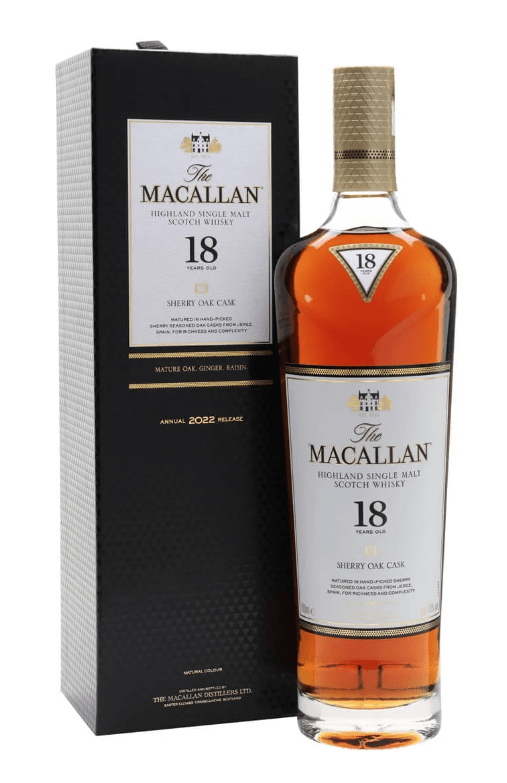
The Macallan Sherry Oak is a vatting of whiskies at least 18 years of age [and older] that spent the entirety of their lives maturing in individual ex-sherried casks. The whisky is bottled at 43.0% ABV, and I’m pretty sure it is also chill-filtered and coloured [the label clearly states “that “Natural Colour“]. There are various releases of this particular bottle, and may I warn you that they would be a little bit different. For example, I am still holding on to my unopened bottle of The Macallan 18, which I brought with me from America (bottled in 2014) – and this one comes exclusively from being matured in “selected sherry oak casks from Jerez, Spain” as the label points out. Whereas most recent bottlings may state that the 18-year-old was matured in “hand-picked sherry seasoned oak casks“, and the keyword is “seasoned“. What that means, folks, is that the casks were not originally used for sherry but were rather purposely filled with the sherry first just to give it that flavour. Why? Because the actual ex-sherry casks are super expensive, and this is the new shortcut that many distilleries now employ. Be on the lookout for that word. But remember, some labels don’t even say that at all! The Macallan Double Cask means that the whisky came from two different types of casks* and then vatted (blended) together to create a specific profile that the distillery was after. That sounds like a great thing, but you also must wonder why the extra effort? Was one of those single casks not good enough to be bottled directly, and the distillery decided to “dilute” it with another to make it work? In my particular tasting, the Double Cask felt slightly younger, fresher, woodier and sharper on the palate. It was just not as luxurious as the Sherry Oak cask.
| Distillery / Region | The Macallan / Speyside | The Macallan / Speyside |
| Producer | The Edrington Group | The Edrington Group |
| Bottler / Series | Distillery bottling / core range | Distillery bottling / core range |
| Stated Age | 18 years old | 18 years old |
| Cask type | Sherry seasoned oak cask | Sherry seasoned American & European oak |
| ABV / Cask Strength | 43% / No | 43% / No |
| Non-chill filtered/ Uncoloured | ? / Yes | ? / Yes |
| Price | £450 | £320 |
| Did it win? / Did I like it? | Yes / Yes – what’s not to like? | No / Yes, but a little woodsy |
| Would I buy it? / Recommend it? | Yes / Yes – stock up now, folks! | Yes / Yes – nearly 100 quid cheaper |
So there you have it, folks, some notes on The Macallan. Whether you hate it or love it, you must recognize its unique position in the world of Scotch whiskies. The bottom line here is that its 18-year-old Sherry Oak is absolutely fantastic, and although I did really try to find a cheaper alternative, there is just nothing out there that tastes the same. But my praise here comes with a warning. Do read the label and make sure you understand where your money is spent! Look out for words such as “natural colour” and “non-chill filtered” [those are the good ones] and “seasoned casks” [not as great as original casks]. Ask yourself why the distiller decided to go for double and even triple maturation? And with those words, I will pause here and proclaim The Macallan 18-year-old Sherry Oak as the winner of this round. I think I’ll need to buy a bottle.
p.s. Speaking of prices, the first hotel charged me £46 for a 50ml pour of that Sherry Oak, while the second charged me £43 for the same-sized pour of the Double Cask. So either the second one overcharged me, or the first one was a very good deal. I will stick with the latter conclusion and may just return there for another sip.
* In my original review, I incorrectly stated that Double Cask meant that the whisky was finished in another cask for a second round of maturation. This is, indeed, the case for some other brands (like The Balvenie), and this term could be confusing because it’s sometimes used interchangeably. I have since confirmed that “Double Cask” in the “Macallan speak” means a vatting of two types of casks (in this case, American and European oak), each no younger than 18 years of age.
 Two Drams A Day
You state that “The whisky is bottled at 43.0% ABV, and I’m pretty sure that it is coloured and is also chill-filtered”. The Macallan definitely does not add E150a to any of its whiskies, and it´s natural colour has proudly been one of the six pillars of its production process.
I think that you may be right on this one. I’ve seen conflicting “opinions” on that, but some labels indeed state “Natural Colour” and that is sufficient to confirm. I will update the article. Thank you.
You mentioned that there are other whiskeys that offer the same experience as the MACALLAN 18, do you have an like to an article that would provide a list of these whiskeys to try ?
That’s a very good question, and is probably worth an article on its own. I’ll think about this some more in depth, but I do recommend you check out anCnoc, GlenDronach and Glengoyene (all have an 18-year-old statement).