Hello, friends and new followers, and welcome back to another side-by-side tasting of two single malts! Today is another interesting pairing, where I dive into the very subtle differences between two [nearly identical] whiskies from the very same distillery! Both drams are from Linkwood, which is owned by Diageo, but each comes from a different independent bottler [and a different single cask!]. I’ll get into the details shortly, but for now, let’s define some things. For clarity, I will refer to the Linkwood bottled by James Eadie as JE and to Linkwood bottled by Phil & Simon Thompson (aka Thompson Brothers) as PST. This is how they are referenced in other online databases (like whiskybase.com), and the whisky geeks like nothing more than consistency. Makes sense? So let’s dive in, but first, we need music! Now Playing: Secret of Elements – Rebuilding Notre Dame.
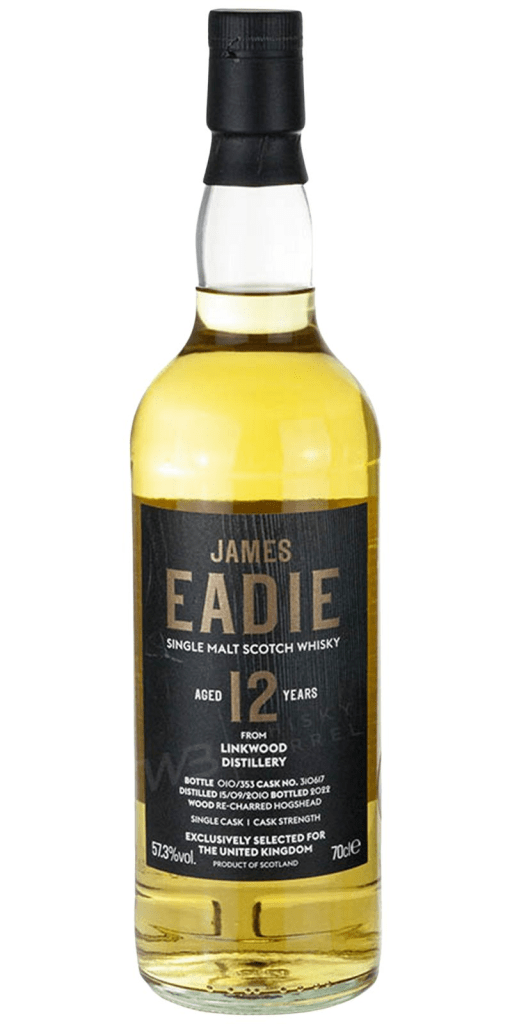
Let’s kick this off by going slightly deeper into the details. As I already mentioned, both whiskies are single casks bottlings, and they are both non-chill filtered and uncoloured and bottled at cask strength! These are all absolutely wonderful characteristics here because we get the whisky unmolested, undisturbed, and unf**ked with, and as a result, both immediately get my integrity star! That’s an incredible start to the tasting, and I cannot wait to try them both. A few more notes before I sip. The JE Linkwood is a 2010 vintage of a 12-year-old liquid from a re-charred hogshead. I’m not sure what it held before because a hogshead is built from staves of other, previously used casks. It could have even been put together from a mixture of ex-bourbon and ex-sherry casks – there is no law that prevents that. As a result of previous contents, the wood itself could be of a different type, including that of American oak (Quercus alba), European Oak (Quercus robur) or Spanish Oak (Quercus falcata). And yes, all that will make a difference in the whisky. The hogshead is then re-charred to bring out those sugars in the oak back to the front, which will impart those traditional vanilla flavours that the whisky drinkers love. As you can see, we’re off to being pretty technical already! Let’s take a step back, then. The PST Linkwood (the other bottle) is a 2011 vintage of a 10-year-old liquid, which also came from a re-charred hogshead. But this time, the bottler explicitly specifies that it was an American Oak. And, albeit younger by a few years, this single malt is at a lower ABV – perhaps it has evaporated faster, perhaps it was diluted just a bit. The JE is at 57.3% ABV, and the PST is at 52.1% ABV. So those are all the vitals then – let’s finally dive in!

I’ll start with the JE bottle first. The colour is just a tiny shade darker than PST. The nose is sharper, hitting you a bit with the ethanol, again attributable to the ABV, so there are no surprises there. Also, the nose is a bit more citrusy on JE, while there are more bananas on PST. Albeit the ABV is a bit high, I’ll still try both neat with the first sip. Let’s go in for a taste! The JE is indeed a little punchy. There is some oak, vanilla, earth, barley, and dry white sherry (?) on the palate. The PST is softer on arrival but instantly gets very woodsy, with that distinct cardboard flavour [I’m not a fan of that], almost drowning out that banana I sensed before on the nose. I’ll add a bit of water to them both (more to JE to bring the ABV down further). And both have opened up! However, now they have changed their profiles – it’s amazing! The JE smells sweeter, while PST went dark. Another sip, then! The JE is full and round now, the oak flavour is gone, and honey replaces vanilla with a smooth and long finish. The PST, however, went sideways, towards the woodsy side now, a bit overpowering the sweetness that was there before. I take a short time out and try them in reverse. I want to clear my mind (yes, I’ll even step out on my balcony and take a breath of fresh air) to see if the PST by itself is very noticeable in oakiness [versus right next to the JE dram]. I take a sip and try PST. Bananas on the nose again, but right after arrival, into development and finish, there is this pungent cardboard flavour. I think the wood was very strong, so the bottler did the right thing by draining the barrel just after 10 years. The JE is just right in terms of ageing, roundness, and finish but lacks a bit of that Linkwood profile that I barely glimpse in the PST.
| Distillery / Region | Linkwood / Speyside | Linkwood / Speyside |
| Producer | Diageo | Diageo |
| Bottler | James Eadie (JE) | Phil & Simon Thompson (PST) |
| Stated Age / Vintage | 12 years old / 2010 vintage | 10 years old / 2011 vintage |
| Cask type | Re-charred hogshead | Re-charred [American Oak] Hogshead |
| ABV / Cask Strength | 57.3% / Yes! | 52.1 % / Yes! |
| Non-chill filtered/ Uncoloured | Yes / Yes 🌟 | Yes / Yes 🌟 |
| Price | £65 | £58 |
| Did it win? / Did I like it? | Yes / Yes – wish it had more “Linkwood” | No / No – way too woodsy for me |
| Would I buy it? / Recommend it? | Not sure / Yes – but only for the real geeks | No / No |
So there you have it, folks. Another fantastic side-by-side pairing, especially because they do appear so close to each other, but as you can see from my notes, they are slightly different in profile. I am inevitably put off by the woodsiness in the PST bottle – and that’s not something that anyone would be able to tell up front! At least not from any notes on the label, the colouring, the price, the age, etc. [in fact, it is the older whiskies that tend to sometimes extract more wood by being “overcooked” in the barrel for longer]. It’s just one of those things to find out while you’re tasting it yourself. And who knows? Maybe you would like the oakey flavour here! At least in my case, I just had the 30ml samples, so I don’t feel like I’ve put out too much cash for these. I’ve also learned a little in this process, and I hope that you’ve learned something too. It all comes down to the barrel! With that said, I will proclaim the Linkwood 2010 12-year-old James Eadie bottling as the winner of this round! And yeah, the PST is a very pretty bottle!
 Two Drams A Day