Welcome back to another fine side-by-side tasting! And today, I am not just trying out single malts! Up for a bout is a pair of two single grains from two Scotch Lowland distilleries, which still makes them whisky and still makes them “scotch”. We’ll discuss the particulars as we discover these together, but first, we need music! Now playing: Hammock – Love in the Void.

Let’s start by understanding the name of these two bottlings. You see, sometimes the whisky is referenced by the distillery and its age and sometimes by the vintage year. This all depends on what the bottler wants to draw your attention to. In the age statements, which are usually prevalent among the distillery bottlings, you are guaranteed the minimum age-stated whisky, but it is still a vetting [blend] of various barrels as the distillery attempts to showcase its signature flavour as represented by the age. Whereas in the independent bottlings, and especially when they are single barrels, it’s more important to understand the vintage, and then, when the bottling date is present, you can arrive at calculated age. This whisky came directly from the cask, and it’s as close to its purest form as you can get. My North British single grain came from the Cask Explorers‘ Advent Calendar, Ruby Edition, as its fifth dram, and the Dumbarton single grain sample from the Southport Whisky Winter Festival from 2022, they are both from the Old Particular series, which is a range of bottling by Douglas Laing. So even though my North British dram is 18 years old, it is referred to as the 2003 bottle. Or, none of what I wrote above here really matters, and the bottler really can put anything on the label they want, as is the case with this Cambus 26-year-old single grain bottled by James Eadie. In any case, the North British distillery produces mainly grain whiskies, primarily for blends. It uses mostly corn and sometimes wheat as the cereal, which it then blends with a bit of green malt for the mash at a ratio of about 5:1. And, unlike the single malt you know that’s made in copper stills, it uses column Coffey stills to extract the spirit at a strength of nearly 95%! Bottled at 48.4% ABV [not cask-strength, mind you – diluted by DL], this single grain spent 18 years in an ex-bourbon barrel. I think the description on my dram is wrong because I found another site that says the whisky came from a butt, and I can smell and taste the influence of sherry. It’s also a bit darker than the “usual” ex-bourbon whiskies, especially at that age. It’s got a smooth arrival, with more cereal on the palate and then the sherry, but it quickly dries out, leaving just the faint oils from the butt.
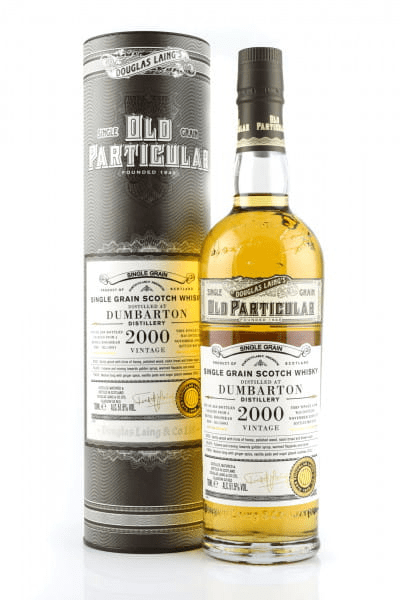
Let’s let it sit a bit and turn to Dumbarton single grain, distilled in November of 2000 and bottled in May 2021, which makes it around 20 years old. This one came from a refill hogshead, and I can see that by the colour. None of these, by the way, have added colouring or chill-filtration. This is something that Douglas Laing does with all of its independent bottlings for the Old Particular range, and as a result, both get my coveted integrity star. Unlike the Edinburgh-based North British powerhouse, collectively owned by Diageo and Edrington Group, Dumbarton, reserved mostly for Ballentine’s blend (and Chivas Regal later), used only maze [corn] in all of its production, which it imported from Canada and America. Its column still was of an American design instead of a Coffey still, and it could also produce neutral grain spirit [so almost like vodka]. The distillery was closed in 2002 as it proved impractical for the column stills to be replaced without wrecking the still tower. It was mothballed and then demolished in 2008. So what I’m drinking here from 2000 is probably the last production batch of this now silent distillery. Sigh. It tastes very much like clean bourbon but at a much higher ABV of 51.5%. There are more bananas here than caramel, and it tastes like a cream-puff sweet with lots of smooth vanilla. I’ll add some water now and see how it sustains. It’s got an undeniable ex-bourbon whisky nose, and then ex-bourbon all the way, but slightly less reminiscent of its American cousins with water now. It’s still a very much clean and sharp dram. Let’s go back to North British now. I sense a lot of sweet, dried plums, chewy toffee, and sticky milk caramel on the nose now. A full and sweet arrival, but then again, it quickly drops, retaining a very long but faint tail in the finish. The Dumbarton retorts, and once again, after the sherried aftertaste, it’s more like a true bourbon. Fascinating! The side-by-side comparison is really working out its charm today! Drinking Dumbarton by itself, it slowly starts to taste like ex-bourbon whisky – but when I taste it right after North British dram, it tastes like bourbon all the way.
| Distillery | North British | Dumbarton |
| Producer | Diageo and Edrington Group | Pernod Ricard [demolished] |
| Bottler / Series | Douglas Laing / Old Particular | Douglas Laing / Old Particular |
| Stated Age / Vintage | 18 years old / 2003 | 20 years old / 2000 |
| Cask type | Ex-sherry butt (?) | Refill Hogshead |
| ABV / Cask Strength | 48.4% / No | 51.5% / No |
| Non-chill filtered/ Uncoloured | Yes / Yes 🌟 | Yes / Yes 🌟 |
So there you have it, folks, another fine pairing of two single grains. My second for the site so far. I do like single grains, but I feel like I want them to be a little bit older, a little sweeter, and most likely aged in ex-sherried casks. This way, they bring more character to that strong ethanol profile. And when I dilute them with some water, they start to taste more like bourbon. And this I think I like from toasted virgin casks. In any case, it’s time to pick a favourite, and I’ll proclaim North British 2003 as the winner of this round. I don’t think you can find these two online [unless you dig them up via the second market], so apologies for not listing out the prices.
 Two Drams A Day