Welcome back to another fine pairing of two single malts, where I discover them side by side, with a goal of picking out those tiny details, learning a bit about each one, and then proclaiming a winner. Today I start off with a fifth dram from the Cask Explorers‘ Advent Calendar, Emerald Edition, which is the Old Pulteney 12-year-old. I’ll pair with the Aberfeldy of the same age and see how they compare. We’ll also talk a little bit about chill filtration, so more on that a bit later, but first, we need music! Now playing: zakè – Past Inside the Future Mix for Headphone Commute.
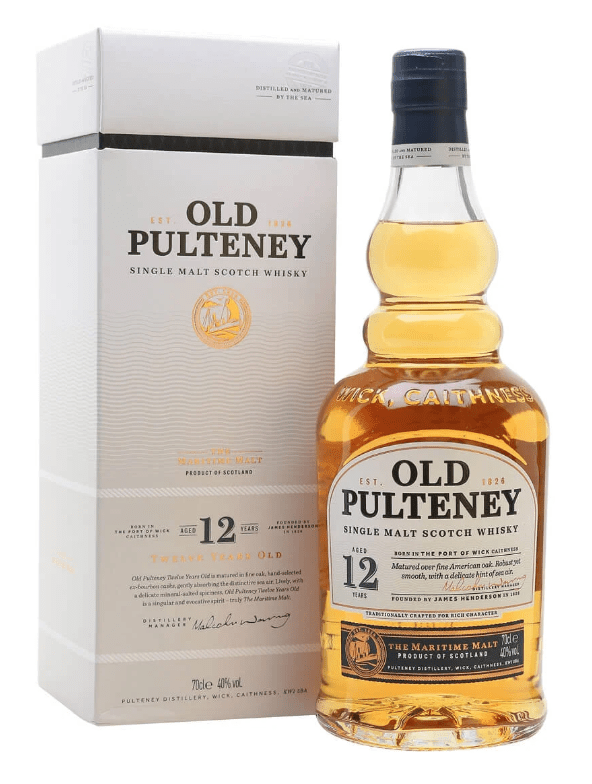
Nestled in the historic fishing town of Wick, in the far northern reaches of the Scottish Highlands, lies the Old Pulteney distillery [officially just called “Pulteney”]. Founded in 1826, this legendary distillery boasts a rich maritime heritage, which is reflected in the character of its award-winning single malt whiskies. With its unique location and traditional distilling methods, Old Pulteney has earned a reputation as a hidden gem among whisky enthusiasts, offering a distinctive “maritime” flavour profile. The 12-year-old in my glass is even subtitled “The Maritime Malt“, but, to be completely honest, I am not really picking up on that particular characteristic. The whisky is bottled at 40% ABV, it is chill filtered, and it is coloured, so I will skip my comments on its appearance, and it will surely not earn my integrity star in the side-by-side table below. On the palate, it has a smooth arrival, which is light, easy-going, and woodsy, with hints of honey and banana. Part of the character of this whisky can be attributed to the unique design of the copper wash still. The pot’s distinct shape features a prominent boil bulb that generates a significant amount of reflux, resulting in a bright and lively nose with a prominent fruity character. Some tasting notes mention citrus in the profile and even saltiness in the finish, but I can’t pick up on those at all. Perhaps not today. It’s got a short and dry finish, and overall it feels like a well-made, proper single malt matured in ex-bourbon barrels. Too bad that it’s bottled at the lowest possible legal ABV. Let’s set this dram aside and try the Aberfeldy now.

Established in 1898, Aberfeldy is a Highland distillery celebrated for its signature heather-honeyed sweetness, smooth and mellow taste, and subtle notes of spice and fruit. Only a small percentage of its production is actually released as a single malt, with the majority going into Dewar’s White Label, branding this distillery as “the spiritual home of Dewar’s whisky“. This 12-year-old is also bottled at 40% ABV. It is also chill-filtered and coloured, so we will ignore its appearance once again. The properties of this Scotch are pretty similar to that of Old Pulteney, which is why I personally selected it for this pairing. Although it’s not disclosed, I believe it is also matured in ex-bourbon casks, but honestly, it is impossible to tell. There has to be some ex-sherry whisky in here [if you know the facts, feel free to drop me a comment]. The taste is thin, dry and satin sweet, with a medium finish, dying out with a bit of cigar smoke on the palette. I pause here for a bit and turn back to Old Pulteney, and now, on the palate, it’s incredibly “vanilla”. This is something that I clearly didn’t pick up until I tasted the Aberfeldy. I wonder why that is. It must have something to do with the contrast in my taste buds. It’s like a cream-filled eclair now on the nose, and the palate echoes all those notes, with sweetness cradled by the caramel. Still no salt, though. Back to Aberfeldy again. It’s definitely darker in flavour and less sweet now. It’s got a bit of an angrier man in there, but it’s a man with more experience and well-earned pessimism aimed at the world. Relative to Old Pulteney, it’s just a teeny tiny bitter – with that distinct reverb of that old-world whisky if you like that kind of thing [I do!]. It’s like an old worn-out teabag [with cold, wet, and used tea in it, of course].
| Distillery / Region | Old Pulteney / Highlands | Aberfeldy / Highlands |
| Producer | Inver House Distillers Ltd. | John Dewar & Sons Ltd. (Bacardi) |
| Bottler / Series | Distillery bottling / core range | Distillery bottling / core range |
| Stated Age | 12 years old | 12 years old |
| Cask type | Ex-bourbon | Unknown [probably a vatting] |
| ABV / Cask Strength | 40% ABV / nope! | 40% ABV / nope! |
| Non-chill filtered/ Uncoloured | No / No | No / No |
| Price | £34 | £40 |
And now, a bit of a rant about chill-filtration! Basically, any whisky below 46% [because science!] will easily go cloudy and hazy when diluted with water or ice, or even if it’s stored at room temperature. The cloudiness is caused by the natural fatty acids, esters and proteins that are present, which are formed during the distillation process, with some also imparted from the cask during maturation. This was a bit undesirable back in the mid-30s by some customers, who have consumed a ton of blended whisky, usually bottled at about 40% ABV. And so the industry responded and solved this “problem” with chill-filtration, which was widely adopted in the early 70s. The process involves cooling the spirit to low temperatures and then removing the “undesirable” particles by passing the liquid through a series of metallic mesh filters. The result is clear and smoother whisky. But were there more than just “impurities” being removed? The whisky connoisseur community unanimously agrees that, yes, many flavours have been “stolen” by the process. This is why you will see some independent bottlers proudly proclaim on the label that their product is non-chill filtered! And I wholeheartedly applaud that!
Back to the closing statement of this round. These two Highland whiskies, albeit very similar, are still slightly different in profile. You’ll either go towards Old Pulteney for its sweeter ex-bourbon-flavoured dram or towards slightly darker, dryer, woodsier Aberfeldy. I’d like to try both once again and, more importantly, their older expressions. For now, it is hard to pick a winner [both are actually not that great at such low ABV], but if I had to choose, I would proclaim the Old Pulteney 12-year-old as the winner of this round. That said, I could have easily been swayed the other way, and maybe, in my next round of these two, I’ll call the other winner. Or perhaps I won’t ever drink either of them again.
 Two Drams A Day