There are plenty of things to avoid at an airport. My number one obstacle, of course, is people, along with their screaming offspring. And yet, there are treasures (pleasures?) to find at a nearby duty-free shop, which could make it all worthwhile. Or at least for a moment or two. You see, the duty-free shops at airports (and sometimes international train stations) not only offer discounted liquor because of the said “duty” not being paid, but many companies (distilleries in this case) showcase exclusive bottlings, not available anywhere else (unless you snag them at a secondary market). So there is an opportunity here to grab a bottle of something very unique to enjoy once you land or to add to your collection. I have recently departed [not in a morbid way] from Heathrow airport in London (December 2022) and, indeed, have picked up something pretty special. But before I reveal my selection, let’s review the various offerings on display. Perhaps your decision will be different than mine. But first, we need some music! Now playing: Plastikman – Consumed.

The first, and rather impressive, in-your-face display, and in this particular case, an entire dedicated “counter”, with a zealous salesperson behind it and all, is from Diageo’s Johnnie Walker. We’ve got the Black here and, of course, the Blue in all of its various permutations of glossy bottlings, inviting the consumer to buy into this luxury brand. But behind the thick and decadent glass is still the very same Johnnie Walker that you can purchase pretty much anywhere, and besides it being all “flash and class”, it is still a very cheaply made, mass-produced and overpriced blend. There. I’ve said it. Okay, the Blue is okay [if it was sold at half-price], but the Black is truly despicable [especially these days], and I wouldn’t drink it unless there was absolutely nothing else available [like maybe on the plane itself – and even then, drowned with ice]. There is also nothing unique in its duty-free offerings. So I walk right past this display, and when I hear a shattering bottle hit the floor (a customer accidentally dropped it and broke the Black), I somewhat snicker – a £40 bottle with £5 worth of actual whisky is no significant loss. And if anyone can afford it, it’s the giant conglomerate that sponsors this massive “pop-up” at the airport (that’s where your money goes, folks). They’re selling a dozen bottles a minute of this stuff. Sorry, I’m not a fan of Johnnie Walker, folks. This is a brand – not a whisky. You can read more about why that is here. But enough negativity. And so I’m moving on!

The other pretty impressive display is courtesy of Glenfiddich. This time, it is, indeed, all travel-exclusive bottlings which are not available in your regular whisky shop. There are four “solera vattings” in this Perpetual Collection, and they are rather interesting. So let’s go over them real quick. Vat 01, aka “smooth & mellow”, is a 40% ABV non-age statement single malt, matured in ex-bourbon and red wine casks. The ABV is a bit light for me here, so Vat 02, “rich and dark“, at 43%, may be a bit more tolerable. It’s also been double matured, but this time, the finishing took place in the Spanish sherry casks. The next in the lineup is Vat 03, bearing a 15-year-old age statement [thank you], no other adjectives, and bottled at a punchy 50.2% ABV. This single malt is non-chill filtered [thank you, again], aged in ex-bourbon and European [not Spanish?] ex-sherry casks. Finally, and perhaps the most enticing of them all, is Vat 04, an 18-year-old, bottled at a perfect 47.8% ABV, non-chill filtered [but probably still with added colouring], a solera blended single malt that spent most of its life in ex-bourbon and [now explicitly called out] Oloroso sherry casks. These are all 1L bottles, going up in price [as expected] in the following order: £47, £57, £62, and £90. I noticed this Glenfiddich back in August, and I think this range is something to keep an eye on, especially if you’re a fan of this Speyside distillery. Read more about the solera vatting process here. I would pick up a bottle of that 18-year-old if I were you [thumbs up for higher ABV!], but let’s see what else we’ve got in stock!

At the airport shops, if you want to find those “traveller exclusive” bottles, you can seek out the little blue square on the price tag of each Scotch. The rest, as previously mentioned, is a pretty standard affair. I spot 1L bottles of a Fettercairn 12-year-old at 40% ABV for £63 [skip] and a 16-year-old at 46.4% ABV for £72 [also skip]. The 12-year-old is PX Sherry Cask, but I will not spend my money on a 40% diluted whisky. Sorry. The 16-year-old is much better, but the only “special” part about this offering for the travellers is the size. You can buy the same release on Amazon, and I see no reason to schlep this particular bottle on the plane. That being said, I do like Fettercairn, and you can read my musings on it here. I also see a Glengoyne Spirit of Time collection offering a 10-year-old first-fill edition, un-chill filtered bottled at 46% ABV for £60 [very nice, albeit young] and a 15-year-old Pedro Xíménez Cask Edition at 48% ABV for £99 [even nicer!]. Both are 1L bottles, and if you like the Glengoyne style [which I do], I recommend you grab the latter. There is also the fabled 26-year-old (1,400 bottles) and even a 53-year-old (only 100 bottles in the world) in this exclusive collection for travellers only, but alas, I do not see them in the shop. I bet they’re gone. I wonder what they would sell for. You can read my praising words on Glengoyne 21-year-old, here.
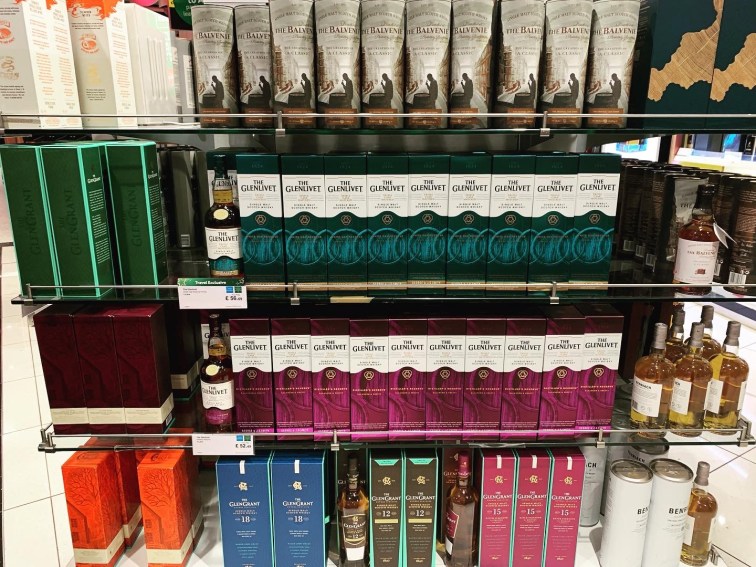
Next, we have Glen Scotia, Campbeltown 1832, an “extra peated” single malt at 46% ABV sold for £53. That might be a bit expensive for a non-age statement whisky, but this is a quality product that I would recommend [so that’s a buy!]. The Glen Scotia Victoriana edition is nowhere to be found, perhaps because, like other Campbeltown whiskies (such as Springbank), it is extremely sought after [especially since it was selected to be the best single malt by Online Scotch Whisky Awards for 2022]. I also spy a Glenmorangie Signet for £127, but, once again, even though it’s a great price, it’s not an exclusive bottling. On the other side, we have The Glenlivet Triple Cask Matured in two editions: Distiller’s Reserve, a non-age statement (NAS) at 40% ABV for £53 [skip!] (same price as Glen Scotia!) and its sibling, the White Oak Reserve, a NAS at 40% ABV for £57 [also skip!]. Here, the Glenlivet is trying to market to an entry-level whisky enthusiast, but they should really look at what Glenfiddich is doing with the higher ABV and a real age statement if they want the “rest of us” to buy. Also, “triple cask matured” could sometimes mean that “double cask matured” just wasn’t good enough. Read my review where I compare Glenfiddich 12 to Glenlivet 12 to see which you may like versus the other. Both are pretty standard single malts, but my advice, however, once again, is to skip out on these 40% dilutions and instead pay for an integrity bottling.

A pattern is starting to emerge – both in the offerings and in my selections. As you can see, I tend to ignore the low ABV, non-age statements, chill-filtered, and over-marketed malts. On the next shelf, I see two Ardbeg bottles: the Corryvreckan [very good, but not unique to duty-free shops] and the Smoketrails [now this is something new!]. The latter is another non-age statement, but it’s a non-chill filtered and uncoloured peated single malt, bottled at 46% ABV and sold for £75 [I mentally award it an integrity bottling label]. I’ve had plenty of NAS Ardbegs before, and not only could it be forgiven for not specifying the age, but I will also proclaim that Ardbeg is better in its younger years. Just like Wee Beastie [which also appears on the shelves]. For Smoketrails, Ardbeg marries whisky aged in the Manzanilla sherry casks and “classic Ardbeg” American oak casks. This is a very enticing bottle, and if you’re a fan of peated whisky (as I am), I would highly recommend it. Speaking of peated malts, I also spot an Extra Rare bottle of Smokehead (this is a heavily peated single malt from an undisclosed distillery [Caol Ila?] on Islay), but it is bottled at 40% ABV, and I am extremely disappointed in that very poor decision of downgrading what must have been a very lovely “extra rare” whisky. Why, oh, why? The saving grace comes back from Talisker, offering a single malt they called Surge – another NAS, bottled at 45.8% ABV and sold for £85. I do not know this particular expression, but it will be less smoky than the Ardbeg above. It will also be chill-filtered, with added colouring, and yes, over-marketed for what it actually is. I do like Talisker at cask strength, but here Ardbeg takes the prize.
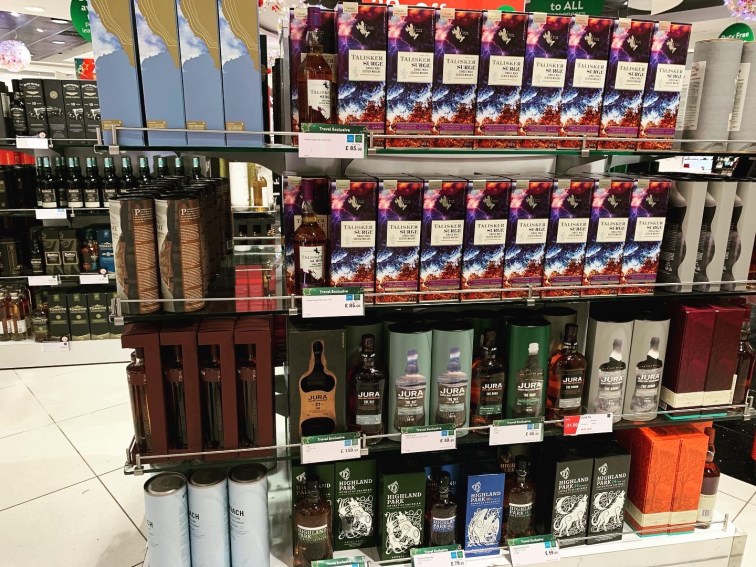
The other two island whiskies are courtesy of Jura and Highland Park. These are both my favourites, and when I compared their 18-year-olds against each other, I couldn’t pick a clear winner. See my review of that here. So what is on offer? Jura has three travel exclusives: The Sound (£32), The Road (£47), and The Bay (£60). I know that there are also The Loch and The Paps, but not in this duty-free shop. Among the three, only The Bay, bottled at 44% ABV, carries a 12-year-old age statement and given that the other two are NAS and are pretty cheap, I think that we can skip them. There’s also a lonely bottle of Jura 21-year-old, mysteriously titled Time, for £160. This single malt was matured in American White Oak ex-bourbon barrels and then finished in ex-peated casks. It’s bottled at 47.2% and immediately jumps as the best contender for my wallet on this shelf. But let’s see what Highland Park retorts with. It also has three travel exclusives: a NAS Spirit of the Bear (£45), a 14-year-old Loyalty of the Wolf (£60) and a 16-year-old Wings of Eagle (£80). We’ll skip the NAS bottled at 40%, consider the 14-year-old at 42.3%, and pause at the 16-year-old bottled at 44.5%. There are no comparable malts of the same age by Jura, but the 14-year-old Highland Park costs the same as the 12-year-old Jura (at a lower ABV). Sigh. Choices, choices! There also exists an 18-year-old Highland Park (46% for £118), but I do not see it here. If your wallet can stomach it, I recommend the 21-year-old Jura, otherwise, the 14- or the 12-year-olds from either of the distilleries. Both are chill-filtered and have added colour. You can ignore the marketing on the bottles – they’re still both decent drams.

Finally, I land on a Balvenie, which, for the record, is owned by William Grant & Sons, just as Glenfiddich. This time I had to walk over to a separate shop called “World of Whiskies“, where about 90% of the offering are the same as in the regular duty-free shop, plus a few interesting bottles. In the past, I’ve seen a few unique expressions of the Balvenie here, and I purchased an 18-year-old finished in a PX sherry butt. I also noticed that the 21-year-old PortWood appeared at a higher ABV for traveller’s retail. Something to note. Today, however, the pickings are slim – perhaps a testament to it selling out. We’ve got The Making of Balvenie Classic, which is part of its Balvenie Stories series, bottled at 43% ABV and sold for £58. Just as the label states, it is a classic, but nothing special to write home about. Suddenly I notice a lonesome and last bottle of The Week of Peat, but instead of the “standard” 14-year-old label, or the 17-year-old that I found online, this one is a 19-year-old single malt bottled at 48.3% ABV and sold for £170. I am a big fan of this expression (even though it’s coloured and chill-filtered), and I never had a 19-year-old before, so I believe my choice on this is clear. For about ten quid less, I can get the older Jura, but although it is finished in ex-peated casks, I know it won’t have the same smokiness as this 19-year-old Balvenie. It would be a great combination of a sherried single malt with Speyside peated barley, further mellowed out with more years. I double-check the ABV again, just to make sure [it would be a hard ‘no’ for me for anything below 44-45% here], and happy that it’s just above the 48%, I decided to pick this bottle for my journey. This is something that I’m sure I can sip neat by the beach at night, and the slight smokiness will only enhance the experience. My choice is made, and I pick up the prized possession [a bit excited with glee, as if I snatched a treasure at the very last chance].

I must conclude here and confirm that I am happy with my pickings. At the time of this writing, I am already a third through the bottle, taking modest sips at night by the beach, and it is smoky and smooth, slightly sweet and a little bit salty, precisely as the doctor prescribed. “This expression has matured just a little longer in three separate types of casks resulting in a single malt rich in honey, vanilla and citrus notes with an extra layer of delicate smokiness. First-fill and refill American oak bourbon casks amplify the peat’s rich smokiness and draw out a syrupy sweetness while Oloroso sherry butts round it out with a new lingering taste of cinnamon and ginger spice.” Yes, please. I’ll drink that. My only disappointment here [as one always exists] is that I won’t be able to bring this bottle home and add it to my ever-growing Balvenie collection.
If you liked this article, check out the refresher on How to Buy Scotch Whisky at a Duty-Free Shop
(it’s more about how to arrive at your own best decision versus picking out the whisky for you).
 Two Drams A Day
Thank you. I enjoyed your post. Your choice is a bit pricey for me, but you can’t beat excellence.
I will be traveling through Heathrow twice this year, and hope to pick up the 19 year old Balvenie, if it’s still available. Thank you for your report, it was helpful.