Welcome to another exciting opportunity to compare two single malt whiskies side by side. The third dram in my Ruby Edition of the whisky advent calendar from Cask Explorers is the Deanston Virgin Oak. Despite my enthusiasm, I was initially disappointed with this third offering due to its lower price point compared to the first two drams from the series: the Glenfarclas 15-year-old (sold at £58 a bottle) and Spice King 12-year-old (£42). However, I decided to embrace this opportunity to try Scotch that I may not have otherwise considered [perhaps that is the purpose of this journey after all!] and found a comparable whisky, the Tomatin Legacy, at an even lower price point. So let’s set aside any expectations and see how these two whiskies compare. But first, we need music! Now playing: Steve Roden – stars of ice.
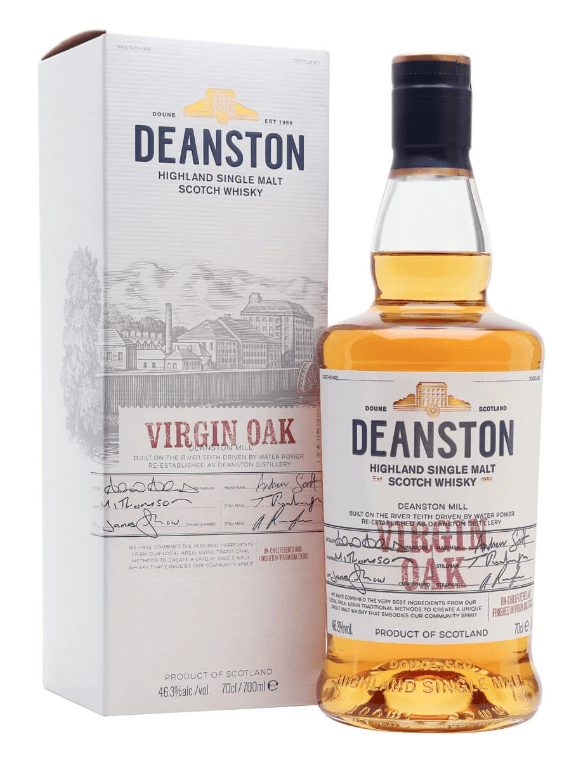
Deanston distillery is located on the banks of the River Teith, in the town of Deanston, near Stirling, in the Scottish Highlands. The distillery was founded in 1966 and built on an old cotton mill site. It is owned by South African Distell Group Limited, which also owns Bunnahabhain and Tobermory. The abundance of water from the river makes it possible to generate its own electricity with a hydro-energy facility on site and power the local street lights. It produces “hand-crafted” single malt with no added colouring and no chill filtration. It is bottled at an excellent 46.3% ABV, as is the rest of its releases in the core range (the 12-year-old and the 18-year-old). It’s got a bright green apple nose, a bit of citrus, and a lingering sweetness somewhere in the back. I’ll wait for it to breathe and turn over to the other dram. The Tomatin Legacy is the opposite of being an “integrity bottling” – it is coloured and chill-filtered. It is lower in alcohol content, bottled at 43% ABV, but not the absolute lowest possible ABV for a whisky (40%). There are even more green apples on the nose, some waxy-coated lemon, and maybe even pineapple. I will reverse the tasting today and start with the Tomatin because it has a lower ABV. Hmm. There is that plasticky cardboard taste that is slightly bitter on the edges. And it’s not the “good type” of bitterness, which I often welcome. It’s got that sulfuric bitterness usually unwanted in my single malt. I do not find this that pleasant, I must say. Let’s switch over. The Deanston is pretty creamy on arrival and is a rounder single malt, but it’s also got that cardboard flavouring again. This time, however, it’s more woodsy, waxy, and oakey, which makes sense.
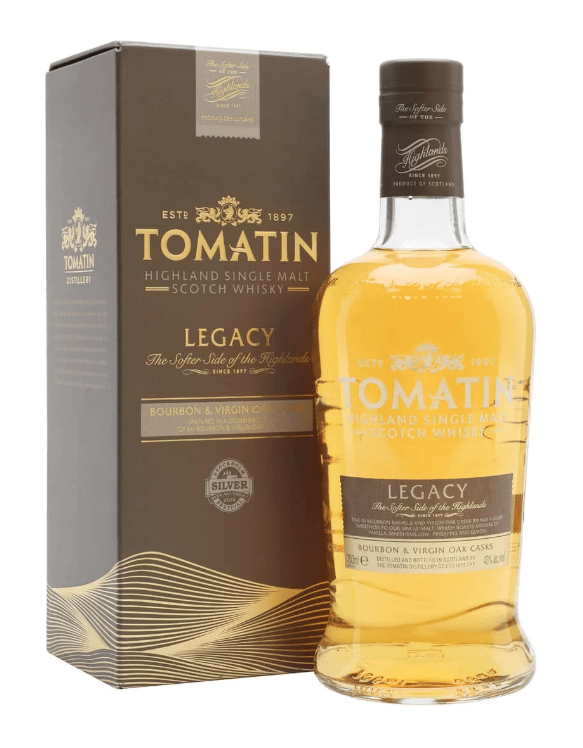
The Virgin Oak is a non-age statement single malt [so it’s a pretty young Scotch, somewhere between 6 and 8 years old], starting off its maturation in ex-bourbon casks and then spending another 9-12 months in previously unused fresh white oak casks from America [so, it’s a “finishing” just like in DoubleWood]. “For Virgin Oak, we source our casks from the Kelvin Cooperage, a Glaswegian, family-run cooperage based in Kentucky,” says the description on casks on the distillery’s website. “The casks are toasted and heavily charred, before being transported across to our home at Deanston for filling with Deanston new make spirit, and then matured in our unique, vaulted ceiling warehouse.” I take a little break between the sips and start with Deanston now, thinking more about that “virgin oak” flavour. There are more bananas on the nose now, and when I sip it, they appear but quickly get overpowered by the wood. It’s a very rounded dram, but I think there’s just too much oak for me in here. It’s all I taste in its rather medium-length finish. Now back to the Tomatin. It is also a Highland distillery,l located near Inverness. It was founded in 1897 and is now owned by Takara Shuzo Co, the largest shochu distiller in Japan. Unlike the “finishing” on Deanston, The Legacy is a vatting (a blend) of whiskies, with 80% coming from ex-bourbon casks [it’s also a NAS, so only a 7 to 8-year-old Scotch here], and the rest coming from that “virgin oak”, where it only spent 4 years. It starts off with a quick flash of something promising and then a torrent of something synthetic, polymer-based, and chemically bitter. I wonder if it has something to do with the miniature bottling. Unlikely!
| Distillery / Region | Deanston / Highland | Tomatin / Highland |
| Producer | Distell International | The Tomatin Distillery |
| Bottler / Series | Distillery bottling / core range | Distillery bottling / core range |
| Stated Age / Vintage | NAS | NAS |
| Cask type | ex-bourbon + virgin oak finish | ex-bourbon & virgin oak vatting |
| ABV / Cask Strength | 46.3% / No | 43% / No |
| Non-chill Filtered / Uncoloured | Yes / Yes 🌟 | No / No |
| Price | £35 | £31 |
So there you have it, folks. After trying both Deanston and Tomatin, I have a clear preference for Deanston. The Tomatin is somehow on par with Johnny Walker or possibly even Grants or Ballentine’s, without all that grain alcohol. And I think that both are entry-level “gateway” whiskies into single malts. Just look at how cheap they are! The Virgin Oak is sold for £35 and the Legacy for £31! Before I conclude, I should mention that in the United States, the Legacy is sold under the Dualchas name, which is Gaelic for “culture, tradition, heritage” and hence, “legacy”. Once again, I think there was too much oak for me in both, so I wouldn’t be coming back, but if I had to choose, I will proclaim the Deanston Virgin Oak as the winner of this round [with an “integrity” stamp to add].
 Two Drams A Day