Welcome back to another fine pairing of two single malts, with the purpose of teasing out those subtle differences and the minuscule details when tasting them side-by-side. I’m always excited to share my thoughts with you, and today, I’m happy to taste one of my favourite drams from Laphroaig! Along the two expressions I am about to dive into in a moment, I’ve also tasted the “regular” consumer-strength 10-year-old. If you want to know how that compares to the cask strength, check out my write-up on Laphroaig 10 vs Laphroaig 10 Cask Strength, in which I sipped on the 12th Batch. I’ve also previously covered Laphroaig 16-Year-Old vs Laphroaig 18-Year-Old, and I’ve got the 25-year-old waiting to be opened! Likewise, you may want to check out the battle of Ardbeg Uigeadail vs Laphroaig Lore and see which one wins. But let’s go back to the cask strengths of this round. But first, we need music! Now playing: Plaid – Feorm Falorx.
Since I have covered this distillery on many occasions, there is not much I can add to the story behind this very smoky single malt. Laphroaig divides the people. You either love it or hate it, and if it’s the latter, you tend to describe the experience in pretty acrid terms. That’s fair! After all, Laphroaig uses that signature peat that tends to be medicinal in flavour. That is because, as of this writing, about 25% of its peat comes from lands near the distillery, which is located on the south coast of Islay. We’re very close to the sea here, and as such, the constituents of the decomposed matter in the peat, which is thousands of years in age, indeed include some marine flora and fauna. This is in contrast to the peat found further north on the island or the mainland of Scotland (where plenty of other peated barley comes from), which, besides heather, contains trees, and thus is woodsier in flavour. The rest of the peated barley [for now] comes from Islay’s Port Ellen maltings, but there is a confirmed rumour that Diageo will limit its supply to other distilleries in 2023 and then stop the following year completely. This is annoying, disappointing, and intriguing, nevertheless, because the profile of Laphroaig will alter as we know it! Now, back to Laphroaig’s peated barley. They’ve got their own malting floor, and the distillery cold-smokes the barley for 18 hours before blowing warm air to dry the rest of it out. Therefore, the peat is used only for flavouring, which gets the barley somewhere around 65-70ppm. As a reminder, the latter phenol measurement is taken before the distillation and, more importantly, before the liquid spends its many years in the cask. So, use that number more as a measuring stick versus an actual attribute of the smokiness of the final product. Okay, I’ve given you more info on Laphroaig; let’s get on to the tasting!

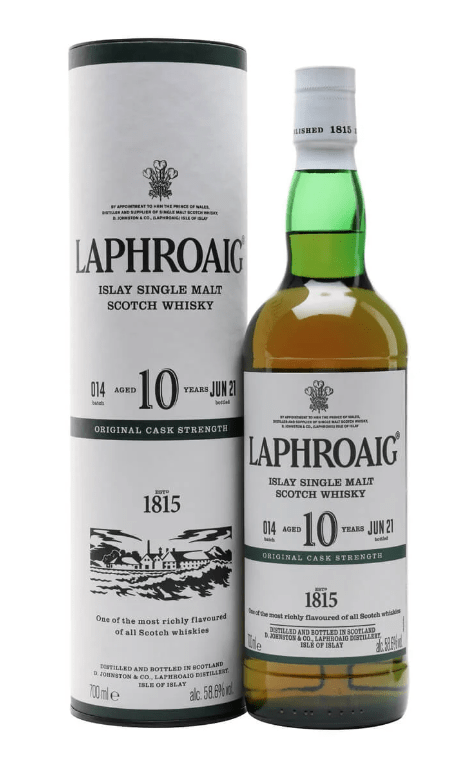
The “Cask Strength” editions of Laphroaig are now released about twice a year, and the shops near me are currently stocking the bottles ranging anywhere from batch 013 to the latest, 015. Each batch contains a selection of ex-bourbon barrels, married together and bottled at a cask-strength ABV. The whisky is neither coloured nor chill-filtered, and therefore, I’ll call this an “integrity bottling”. You’re coming as close to the true Laphroaig right here as possible unless you are drinking from a single cask (you can try and find a few independent bottlings of this one online) or directly from the barrel. Because the final liquid will vary with batches, even the ABV is different. So Batch 014, from 2021, is bottled at 58.6% ABV, while Batch 015, from 2022, is bottled a few points lower, at 56.5% ABV. So, can we tell the difference between these two batches, half a year apart? You betcha! They’re both Laphroaig, of course, and this is very clear, but Batch 015 is somehow more complex. It’s slightly darker, meatier, and just a wee bit sweeter. I almost feel there is some sherry in the blend. And is that possible? Who knows? Most likely not, and it’s the slight variations in the barrels, the seasoning, the charring, and yes, even the location in the warehouse that could contribute to the flavour and lower ABV [as a result of the evaporation of the liquid]. Perhaps it’s slightly more concentrated in texture, and therefore it’s dense and rich. I add a few drops of water to Batch 014 and a lot less to Batch 015 to compare. Both open up and start to breathe, but Batch 015 still has that depth which Batch 014 makes up with phenols. There is that vanilla, toffee, and sea salt on the palate in both, but Batch 014 is slightly more floral with barbecue flavours, while Batch 015 is more leather and tar with tobacco smoke. Which one’s for you?
| Distillery / Region | Laphroaig / Islay | Laphroaig / Islay |
| Producer | Beam Suntory | Beam Suntory |
| Bottler / Series | Distillery bottling / cask strength | Distillery bottling / cask strength |
| Stated Age / Vintage | 10 years old | 10 years old |
| Cask type | ex-bourbon barrels | ex-bourbon barrels |
| ABV / Cask Strength | 58.6 / Yes | 56.5% / Yes |
| Non-chill filtered/ Uncoloured | Yes / Yes 🌟 | Yes / Yes 🌟 |
| Price | £75 | £75 |
Well, there you have it, folks, another in-depth pairing. I feel like you must try them out yourself and pick the one that wags your tail. They’re [currently] both the same in price and go for about £70-80 in my neck of the woods. Of course, you can expect to pay a premium the longer you wait to buy these batches, as the supply will surely dwindle with time. For example, Batch 012 is currently somewhere around £170. Expect to pay £400+ for the first edition of the series. Are they worth it? It’s really up to you! I am a fan and currently own batches 10 through 15 [two of each, for now]. Between the two I have compared in this tasting, I think I’ll want to reach for one with just a bit more substance in the punch. So, I will pause here and proclaim Laphroaig Batch 015 as the winner of this round. And if you like this type of content, stick around and subscribe!
 Two Drams A Day