On Two Drams A Day, I often compare two single malts (mostly Scotch) and, on occasion, a blend or two. And although I find myself gravitating towards the older and more expensive whiskies [I’ve got a 30-year-old I will be tasting tonight], I do often “reset the bar” and drop down to the easily accessible bottles, including the ones from your local supermarket or the nearby watering hole. Let’s make one thing clear – there’s nothing wrong with the blends! Not only do they dominate the entire alcoholic beverages market, but this is indeed how we got here today – if it wasn’t for the blends, there would not be any single malts – they are the main components! So let’s take some time and peel apart these two expressions. But first, we need music! Now playing: Taylor Deupree & Marcus Fischer – Februarys.
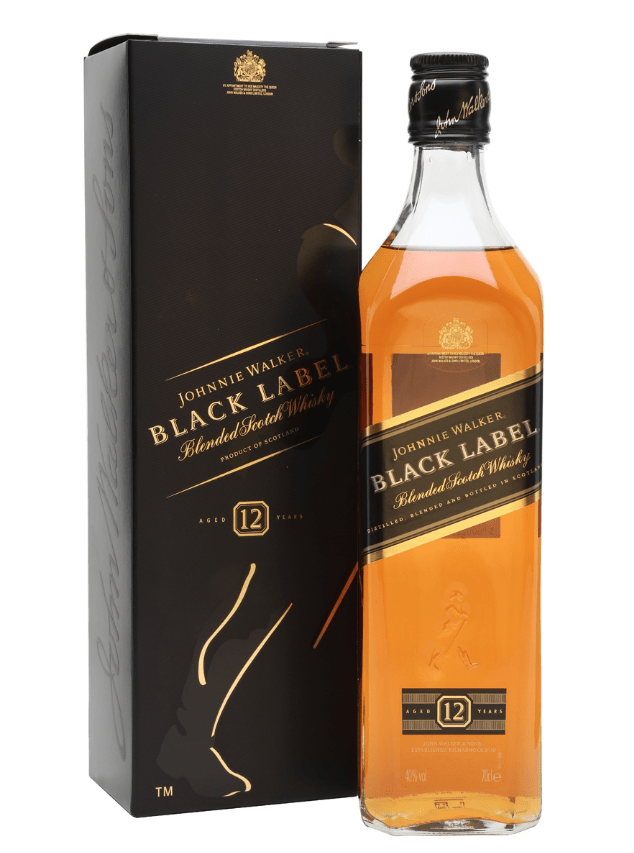
I’ve previously covered Johnnie Walker Black Label when I compared it against its very own Gold Label Reserve. This is a staple 12-year-old blended whisky – which means that it’s got malted barley and grain alcohol in it. First, look at the colour, and then forget everything that you see – it doesn’t really mean anything, nor does it tell you anything about the whisky. This is actually the case with all single malts (meaning, the colour translates into nothing), but in this particular case, the amount of additional colouring added will literally trick the mind into thinking that it’s somehow older or richer in flavour. Ignore this, please, from now on. There are two main components in the Black Label. The majority of it is made up of whisky produced by Diageo‘s working horse distillery in Speyside, called Roseisle. The reason you may not have ever heard of it is that there is no independently bottled single malt produced by it – it’s literally only used to make the whisky for Diageo’s blends. It’s an absolute monster of an industrial-level production plant with 14 stills, pumping out new spirit at 70%, producing about 10M litres per annum. The grain whiskies come from Diageo’s Cameronbridge, which, apparently, is the only distillery in the Diageo family that uses first-fill bourbon and x-sherry casks – the rest of the distilleries in the portfolio almost always use re-fill casks for all their single malts. Another thing to note about Black Label is that each year it does taste slightly different – a point that is well pronounced between the decades. In fact, before Roseisle, Diageo indeed used all the known single malts for the Johnnie Walker blends – so try and find an older bottling from the 90s to really taste the difference! For me, Black Label still tastes harsh. It’s dark in flavour and slightly spicy on the palate, but it is strong in ethanol which is scratching at my throat, even at 40% ABV. This middle-shelf blend (the Red Label is even lower) goes for about £27 a bottle, and it’s not something that I would reach for unless I was in real need [like, my parents are visiting me, and we’re at a place where they only have Johnnie Walker].

The Teacher‘s Highland Cream is an unexpected surprise. First, let’s talk about the name. When I first heard of it in the UK, I was immediately turned off. Cream? For teachers? At 25 quid? What? No, thank you! Then, just the other day, I came upon a dram from Cask Explorers from a highland distillery called Ardmore. It was a peated single malt produced by Beam Suntory, who also owns Laphroaig and Bowmore! It was absolutely delicious, and I ran out to buy a few independent bottles of Ardmore right away. But what I also learned is that it’s the main ingredient in Teacher’s, and then I realised that this brand was created by William Teacher in 1830 – so it’s just his last name and not a profession for which this scotch is blended! Too bad! I think all teachers need some highland whisky! So this is how I ended up buying a bottle of Highland Cream, which is indeed a little creamy in its texture and softer on the palate than the Johnny Walker Black Label. There’s just a hint of smoke here which is echoed in the Ardmore, but it is mostly full of ripe bananas, honey, and some dried fruit. It’s lighter and much smoother than the Black Label and possibly contains less of that grain ethanol that puts me off in mass-produced alcohol. It’s also bottled at 40% ABV and most likely contains plenty of colouring, but somehow it tasted a lot more “maltier” than the Black Label. Contrary to the above, I think that the Black Label is more complex and even a bit gritty in its character – something I sometimes desire from my whiskies. But while I can simply take down a big sip of Highland Cream in one swooping gulp, I just can’t do that with the Black Label without cringing my face. Look, I’m under no delusion here that Beam Suntory is another multi-national conglomerate. It is the third-largest producer of distilled beverages behind Diageo and Pernod Ricard. I’m pretty sure that the whisky in the Highland Cream is also mass-produced. But somehow, it feels just a tad less synthetic, as if fewer shortcuts have been made in the production chain. It tastes like blended whisky from its constituents, rather than extraction of ethanol behind the brand diluted down to a product.
Okay, I will conclude here. I think it’s clear from my words that Black Label falls behind. The good news here [for Diageo at least] is that my words bear no consequence to sales. In fact, I feel like if all the drinkers in the entire United Kingdom never buy another Johnnie Walker blend, it still entirely doesn’t matter. With that, I will proclaim the Highland Cream to be the winner of this bout. And if you haven’t tried it, I truly recommend it! If you like this type of content, stick around and subscribe!
 Two Drams A Day