It’s time to taste some single-grain Scotch whisky and see how these two different distilleries and bottlings compare against each other. Now, I’m usually not a fan of grain whisky and often grumble about its harshness when it is used in blends. On the other hand, I do enjoy American and Canadian whisk[e]ys, and isn’t a 100% rye a single-grain whisky? I think what makes a single-grain whisky more interesting is the proper ageing in carefully selected casks versus just using it as a filler ingredient to lift up the more expensive single malts with higher alcohol content. It’s just economically more viable. And I think, as a result, it brings down the quality of a blend. But here, we’ve got some pretty old drams from two independent bottlers, so let’s see what it’s all about! But first, we need some music! Now playing: Yair Elazar Glotman – Speculative Memories.
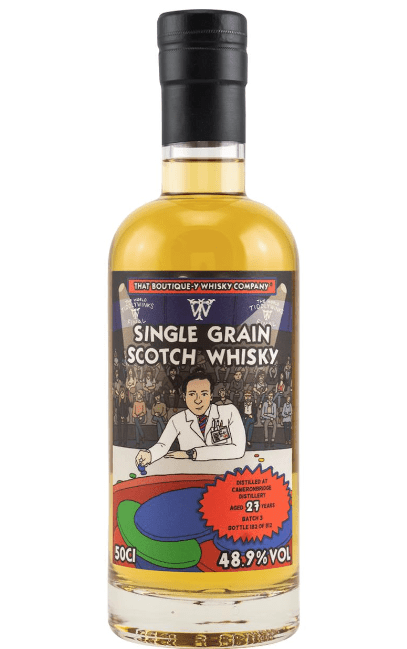
The first pour is from That Boutique-y Whisky Company (TBWC), and it’s a 27-year-old single grain from Cameronbridge distillery. Mine comes from Batch number 3, bottled at 48.9% ABV, and I’m pretty sure that it’s a vatting from various casks, and unfortunately, it doesn’t say which types. This is a £100 bottle, but do note that it’s only 50cl. Cameronbridge is one of the largest remaining grain distilleries, which is owned by Diageo, and it is being used to produce alcohol for, you guessed it, many of its blends, including, of course, Johnnie Walker. It’s very light on the colour and nose, and although I do sense a just bit of those bourbon notes, with fresh green apples and some vegetative elements, like maybe fresh sunflower oil, it does still hit me with the ethanol on the nose, and I already know that I’ll be adding water down the line. Let’s go in for the very first taste. It’s much smoother and sweeter than I thought it would be. It’s even thicker on the palate, with some very distant coconutty flavour. I’ll add just a tiny drop of water and see how it evolves. The ethanol is gone now from the nose – good! – and now it starts to really remind me of a single malt. It’s very drinkable and isn’t harsh at all. It tricks the mind – sometimes I think it tastes like bourbon, sometimes a Scotch aged in the bourbon casks, but at the very end, it does again suggest that it’s a single grain – it’s got that gritty character I often glimpse in blended whisky. I’ll add another tiny drop and let it stand for fifteen minutes. Meanwhile, let us turn to the next dram.

The second pour is from James Eadie (JE), and it’s a year younger, 26-year-old single grain from the now-closed Cambus distillery (also previously owned by Diageo). I checked out JE’s site, and this independent bottler also has a Cameronbridge, but let’s turn back to Cambus. This one is a bit stronger, coming from a single cask at 55.4% ABV, and, more interestingly, it was a sherry butt! I can immediately see that just by the colour, as it is amber brown, pretty dark, and on the nose, it is super sherried, like a cognac-drenched fruitcake, but then it’s musky, woodsy, and a bit funky. This one was distilled in May of 1993 and bottled in 2019 into a cask 48094. I don’t remember where I got mine, but you can find it for about £92 online. Let’s go in for a taste! Whoah! It’s very deep and sweet in texture, with elements of chocolate, waxy coating, and oak – it’s concentrated, thick and oily, with lots of sherry on the front. Reminds me a bit of that Christmas edition of Williamson that I got at Berry Bros. & Rudd – it’s as if someone accidentally forgot all about this barrel and had it sit in a damp basement for an extra decade without any tending to. I’ll add a few drops of water to see what happens next. The funkiness is somewhat gone, and now ripe cherries, plums and candied fruit welcome me to plunge into this sherry pool. It’s still a little waxy on the edges, but ethanol breaks up the oily traces. I wonder if, in a blind tasting, I would tell that it’s a single grain – it’s got a bit of maltiness with a woodsy character I’m used to from a single malt.
So there you have it, folks. I’ll go for one last taste of each and see which one will grab me. There are bananas on the palate in Cameronbridge now after time. It’s very rounded on arrival but then thins out towards the end and fades away just like a blended whisky. The Cambus is a fuller dram with way more character and texture on the palate. It still holds on a little to that funk, but it is now like Armagnac with a long and sherried finish. I think that between these two, it will come down to a preference for sherry. For me, the Cambus slightly edges forward (if only it wasn’t for that musk!), but then I keep returning for a sip of Cameronbridge. So, honestly, I think I’ll nearly have to call it a draw here. Oh, and I forgot to say, the Cameronbridge was the first dram from my Boutique-y advent calendar (2022) – it’s an interesting opener to the journey, and I’m curious to see what they have in store for me next!
p.s. A few days later I had a taste of a 26-year-old Cameronbridge, this time bottled by the distillery itself for Diageo’s Special Releases series, 2022 edition. I know that I didn’t compare these two side-by-side, but just from my notes, I know that I liked the TBWC bottling better. Diageo’s presentation was just a lot thinner, sharper, and probably augmented in many other ways.
 Two Drams A Day