In December of last year (2021), I opened up my first whisky advent calendar and was greeted with a dram of Aerolite Lyndsay. More than a pleasant memory, I ended up capturing this experience with my very first words on Two Drams a Day. Since then, I have published a total of 80 write-ups! Well, this year is not over yet, and there are still a few months left to make it to 100! So today, I’m popping open a brand new calendar courtesy of Cask Explorers. I’m skipping their £100 Sapphire Edition and jumping straight into the £150 Emerald Edition of 25 great drams. I also have the more expensive Ruby Edition, and, yes, the Diamond Edition as well, which I’ll probably crack open a little bit later. And no, I have no idea what’s awaiting me, exploring the drams in the prescribed order… starting with number one, which is… drum roll, please… [I’m digging into the cardboard box and pulling it out as I type this]… Glenfarclas 15-year-old! Alrighty then! Let’s get some music going! Now playing: John Lennon – Plastic Ono Band.

I’ve had this single malt before and remember really enjoying it. But I’ve never had it in the context of a pairing [edit: that’s incorrect – I have compared it to the 25-year-old here], so I’m pretty excited to compare it against something worthy. What shall I pick? I spend about fifteen minutes scanning through my collection and land on the GlenDronach, which is precisely of the same age and even the same ABV. Both are sherried single malts, so I think this pairing is very fair, no? So, let’s start with the Glenfarclas and see how we get on! I have to admit, I am already a fan of this Speyside distillery, and the 15-year-old, which goes for about £58, is an excellent value for your money. I say this because it quickly goes up in price, with the 17-year-old going for almost £100 and the 25-year-old at £215 (which is worth it!). This 15-year-old has no colouring, is not chill-filtered, and it’s a beautiful, rich golden amber. It’s got more sherry on the nose than the GlenDronach, and it is slightly fruitier and sweeter with every single whiff. It’s just more pungent (in a good way), with notes of red cherries, plums and raisins. I have to dig my nose a bit deeper into the GlenDronach glass to pick out similar notes, and then I notice that the latter is a bit “darker”, like rum cake with caramelized apples. I feel it may end up sweeter, as it is also slightly darker in colour. Both of those attributes are for the fact that this Scotch was aged in a combination of Oloroso and PX casks, whereas [I think] there are no PX casks in the Glenfarclas. And now that both have spent 15 minutes in their glasses let’s go in for a taste!
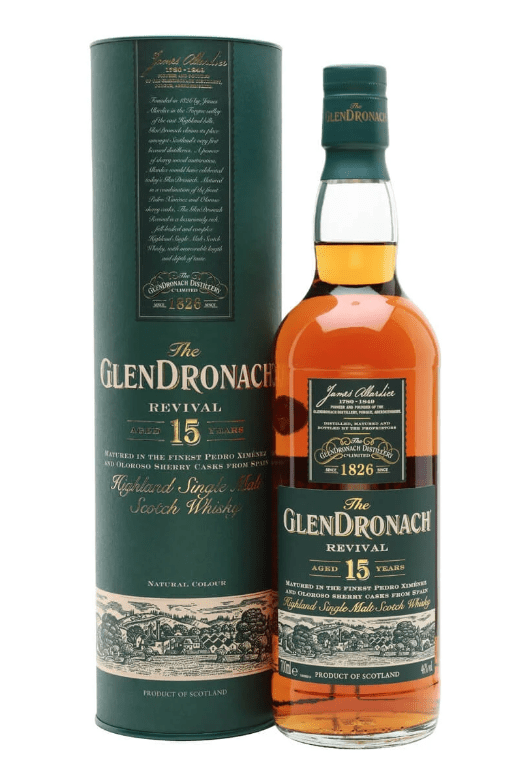
The Glenfarclas is an easy sipper. It goes down smooth and light, and it is really just perfect at its 46% ABV. Unlike their 10-year-old at 40% [meh!] and the 12-year-old at 43% [better], the 15-year-old is bottled at 46% “because my grandfather preferred it at this strength,” says John L.S. Grant. It’s almost buttery on the palate, with spicy cinnamon and dried winter fruit. I turn to the GlenDronach now, and it is more oaky, not as sweet as I initially expected it to be, and possibly a tad more viscous in consistency. It’s got a bit of a citrusy tang cutting through its Christmas fruit cake flavour, and it comes out in waves, unlike the Glenfarclas, which is consistent in its profile curve. I take a sip of water and reverse the tasting. The GlenDronach is subtitled a REVIVAL because it was an outstanding expression before it disappeared from the shelves, and now it’s back as part of this highland distillery’s core range. It is uncoloured and is definitely non-chill filtered, so, just like Glenfarclas, it’s an integrity bottling, as mentioned, at the very same 46% ABV, sold a bit higher, at about £69. It has that wonderful satin mouthfeel now, with more sweetness coming through on the long finish. Switching back, the Glenfarclas is definitely softer on arrival, developing throughout with a lovely sherried curve. There’s a tiny touch of smoke in this Glenfarclas, but it is very, very far behind its full and sherried flavour. The GlenDronach has that satin flavour at the forefront once again, and it’s just more complex and interesting than the Glenfarclas. I feel like there are much older whiskies in this single malt. I feel like this 15-year-old can easily compete with the Macallan, aged for 18 years [gets up and pours himself a dram]. Yeah, there it is.
| Distillery / Region | Glenfarclas / Speyside | GlenDronach / Highland |
| Producer | J.&G. Grant | Brown-Forman |
| Bottler / Series | Distillery Bottling / core range | Distillery bottling / core range |
| Stated Age / Vintage | 15 years old | 15 years old |
| Cask type | [Oloroso?] Sherry | Oloroso Sherry & Pedro Ximénez |
| ABV / Cask Strength | 46.0% / No | 46.0% / No |
| Non-chill filtered/ Uncoloured | Yes / Yes 🌟 | Yes / Yes 🌟 |
| Price | £58 | £69 |
And there you have it, folks. It’s time to wrap this up. Neither of these single malts is a sherry bomb, and both are balanced perfectly for my palate. With that last taste, I think I found that little something which edged just one of them ahead. It’s that complexity and age and that slight spiciness which sets GlenDronach just above, and with the extra PX cask, it offers up that darker, more tobacco-tinted flavour. It’s something which I really like, but if you don’t, go with Glenfarclas – it’s a great dram and £10 less! Alas, this time, I’ll pause right here and proclaim the GlenDronach’s 15-year-old as the winner of this round.
p.s. I’ve also learned that at one point, there was a GlenDronach 15-year-old that was purely from ex-oloroso casks, with no whisky aged in PX casks in it. Interestingly enough, it was also called the REVIVAL. This once again proves that every single bottling is different. Read the label!
[Update a year later]. I’ve also since learned that the GlenDronach removed “non-chill filtered” words from the label. Do with that info what you will, folks, but remember, the label is the contract between the distillery and the buyer.
 Two Drams A Day