Welcome back to another fine pairing of two single malts, with the purpose of teasing out those minute details and the tiny differences when tasting them side-by-side. Today, I am particularly excited to taste one of my favourite drams from Laphroaig, but, as you have already keenly observed, one is a “standard” bottling at [only] 40% ABV, while the other is the Cask Strength edition, bottled at a whopping 60.1% ABV! To be more precise, my cask strength bottle is the Laphroaig Batch 12 from 2020. I mention this because the current Cask Strength Batch 13 from 2021 is bottled at 57.9% ABV – something to keep in mind when you’re hunting for this one, folks. To avoid confusion, I would refer to them as the standard and the cask strength in the following write-up. So, let’s get to it, shall we? But first, we need some music! Now playing: my Spotify Release Radar.
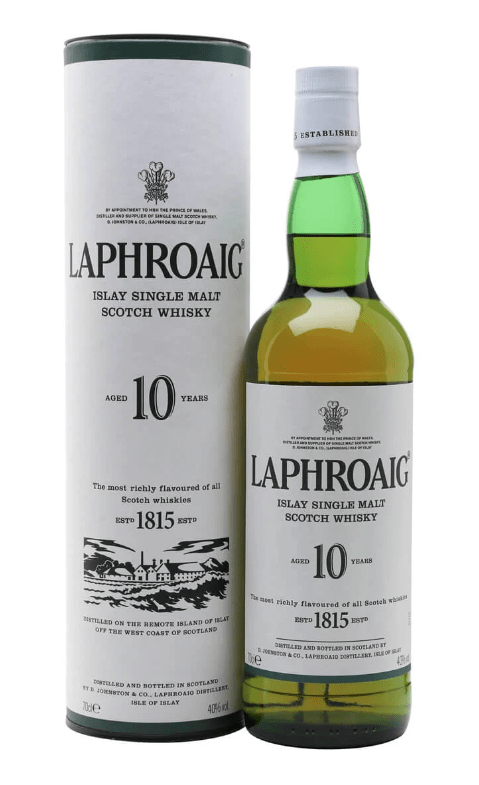
The scientifically and mathematically inclined among you may quickly do some calculations, arriving at the following, possibly irrelevant fact: there is just more “Laphroaig” in that cask strength than in the standard bottling. To be precise (why not, eh?), if you want to dilute a 700ml bottle from 60.1% down to 40%, you’ll need to add 351.75 ml of water! Now that’s a half bottle more of just plain water! Now, wait a second! So does that mean an £80 cask strength bottle is actually £120 worth the standard pour? I guess that’s somewhat true, but I’m afraid that it’s a lot more complicated than that. And that’s in taste alone! So that’s what we’ll find out! Let’s do the sight and smell test first. The standard is just a tiny bit darker in colour, and there are no legs in my Glencairn, whereas the cask strength leaves oily tears on the glass walls. I feel I could have easily predicted that. And on the nose, as suspected from the alcohol alone, the standard‘s weak and flat (it’s still Laphroaig, don’t get me wrong, so that’s a comment in relation to the other), whereas the cask strength bites and claws, but not in an aggressive way – it’s fuller, wider on the spectrum, covering a range of flavours I detect.

I take the first sip of the standard 10-year-old… and there it is… the Laphroaig that I well know and love. Even at 40%, it seems to satisfy and tickle, with its phenolic scratch in all the right places. It’s just exactly right, and now that I have baselined for my journey, I take a breath and reach in for the cask strength. And yes, it’s sharp and strong and even slightly burning, with the initial bitterness and overwhelming punch. It’s gonna need a lot more water than a teardrop, so I will add a couple capfuls now and see how it hangs on while I recompose myself for yet another round. Let’s start with cask strength this time. There’s sweetness on the nose now, with fiery smokiness and an earthy, burning pit. The standard smells a little waxier (?) and tamer, whereas the cask strength carries on that vivid rainbow through and through. The standard tastes now like a backwash (sorry), but still with a long finish and a graze. The cask strength, on the other hand, is fuller, slightly darker, rounder and thicker, with plenty of umami, iodine, burned wood, and bitter herbs. I’ll add a bit more water for a final taste. I’ll even pour a drop into the standard just to give it a chance to open up. It took it well and mellowed out. But it holds on to a distinctive curve, where in the finish, the tail is elongated and a little jagged and almost disproportional in length to the initial body. The cask strength balances this journey rather well, concluding with a memory that’s lasting.
So there you have it, folks, at last, a taste of two. I have to say this right away – the cask strength wins this round, hands down. And not just for its stronger, tougher stance. For when I bring it down with more water to levels that compare with the standard (and beyond), it offers so much more in a span of sharpened flavours, whereas the standard feels deflated and curtailed. My only disappointment with the cask strength is to discover chill-filtration in my glass. Oh, why, oh why? The older bottlings of the very same 10-year-old cask strength had “Scottish mist” after some water – a fact I have confirmed by watching some online reviews. Alright, I’ll see if I can find an older bottle. Till then!
 Two Drams A Day