Tasting whisky side by side indeed creates perspective. I am reminded of this fact over and over again. Especially when, at the end of this tasting [to which we will get shortly], I have poured myself a dram of a very peaty blended malt, which I’ve been marrying myself for a couple of weeks now (it’s mostly wine-finished Caol Ila with a fifth of Laphroaig), and… damn, it hit me like an oncoming freight train. At first, I thought that my experiment in blending really failed. But only upon the second, third, and fourth sip did I start to recognize the naked beauty of Caol Ila, which, by itself, was always there from the start, but after all, the sweetness of these malts, completely hidden from my taste buds. So yes, a bit of a diversion in this prelude to the post, so let’s get back to business. But first, we need music! Now playing: Ben Frost – Fortitude.
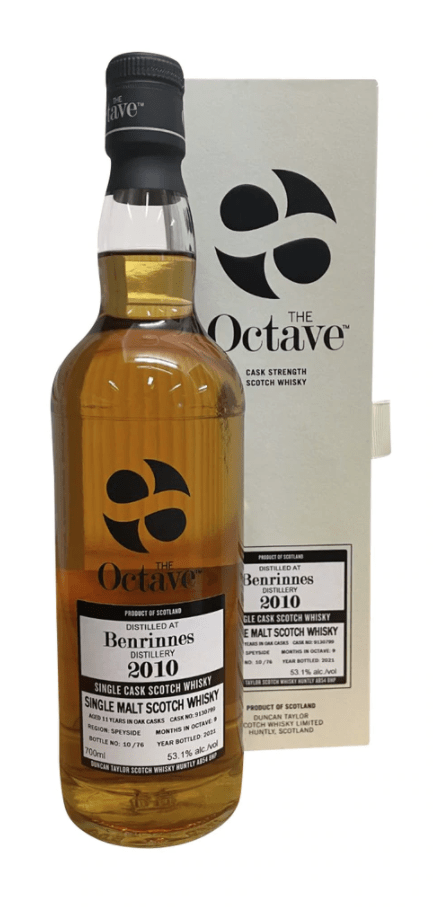
Let’s chat a bit about the producer first. Duncan Taylor is an independent bottler originating in Glasgow in 1938 as a merchant and Scotch cask broker [traded between distilleries and companies that produced blends]. Over the years, they have acquired many interesting barrels, which are still maturing in their warehouses today [looking forward to these!]. Now, as an “alcoholic beverages” company out of Huntly, Duncan Taylor produces many single malt brands, blends, as well as rum and gin. Yesterday I tasted some whisky from their new Single Cask range, and today I’m checking out the Octave. Initially matured in an ex-bourbon hogshead, the whisky from the Benrinnes, distilled in 2010, was transferred into a sherry octave cask for its second maturation. There, it only spent 9 months out of the total of 11 years, but even these nine will equal to three years in a sherry butt due to the larger surface area contact of wood to liquid. The Benrinnes distillery is from Aberlour in Speyside and is now owned by Diageo, which uses most of its spirit for the blends. This is sweet, viscous, and chewy malt. I love the oiliness of this one and the way it coats the inside of my mouth. There is plenty of caramel and spice in there, with less fruit now and more candied Christmas cake. It trails off with more spice and pepper in a medium finish. It comes in at 53.1% ABV, with only 73 bottles in the world! There is a lot of body in this dram, which explains why this “meaty” malt is used to add substance to the blends.
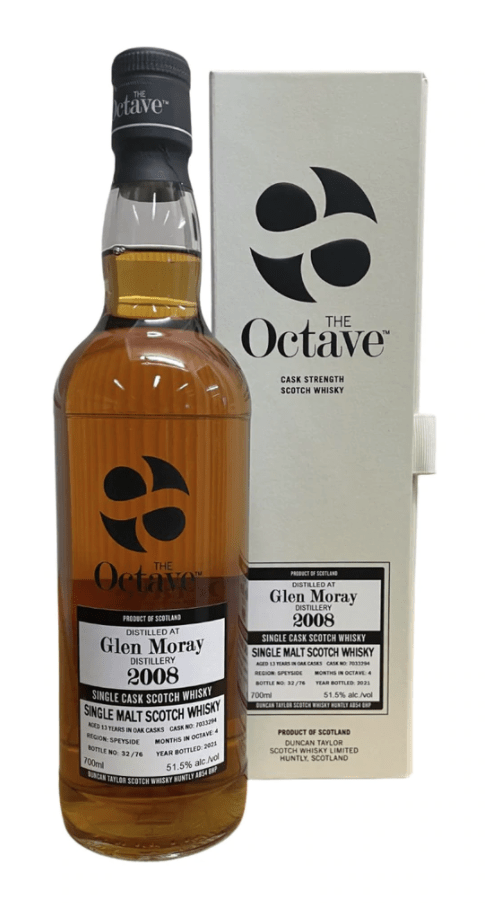
Back to the Octave range, of which I already have a few bottles in my collection. As the name suggests, an Octave is an 8th of the size of a sherry butt (hence the Latin “octavus” in there). Because the barrel is smaller, the whisky “matures” faster. Okay, maybe “maturation” is an incorrect word because it does not actually speed up the process. But it certainly is more in touch with sherried wood, and thus it takes on more of its flavour. So the whiskies aged in octave casks tend to be sweeter, rounder, and more coloured [without any artificial means] because of the extraction. This Glen Moray single malt spent only 4 months in the octave casks, out of its total of 13 years [it was bottled in 2008], but it’s already darker than the Benrinnes right away. Situated on the banks of the River Lossie in Elgin, the Glen Moray is a Speyside distillery, which, in 2008, was sold by the Glenmorangie to a French La Martiniquaise. The latter uses its spirit in blends like Cutty Sark, and you may never even taste the malt unless an independent bottler such as Duncan Taylor gets their hands on a unique barrel. But this is still an ‘up-and-coming’ distillery, so we may not see older whiskies from its range. This dram comes in initially sweet, but with a bit of water, it tastes slightly bitter on the finish. There is more sherry, dry and desert-like, but the flavour quickly dissipates and begs to be revisited again. Overall, this dram is just a bit more muted than the Benrinnes. Also bottled at a cask strength of 51.5% with no additional mangling of the spirit, this bottle is a great example of a whisky taken just beyond its expectations to become more rich, complex and wise beyond its years.
During the tasting, I was surprised at my ability to sip these whiskies straight at cask strength. But I also appreciated the subtle change in flavour with a bit more water, especially in the Benrinnes, which, after the initial blast of sweetness, opened up a bit while holding on to all of the notes observed initially from a neat pour. And yes, it still felt oily in a good way. There are plenty of other bottles that I’m interested in, like Highland Park, that’s bottled in an octave, or Caol Ila, or Laphroaig. An interesting range to savour and explore. With that said, I’ll pause here and proclaim the Benrinnes as the winner of this round.
 Two Drams A Day