In a [lemon] twisted turn of events, we come to a tasting of straight whiskeys. And yes, I’m finally spelling the word whisk[e]y with an ‘e’, as this is the first time I’m doing a tasting [on here] of American spirits. There may be more to come, but for now, I am exploring these two particular whiskeys, one of which is made out of rye, while the other of corn [among other “ingredients”]. We get to learn a bit about the process and how it differs from that of scotch, putting our single malts into [another] perspective. So let’s get right to it, but first, we need music! Now playing: Jóhann Jóhannsson & Jonas Colstrup – The Shadow Play (OST).
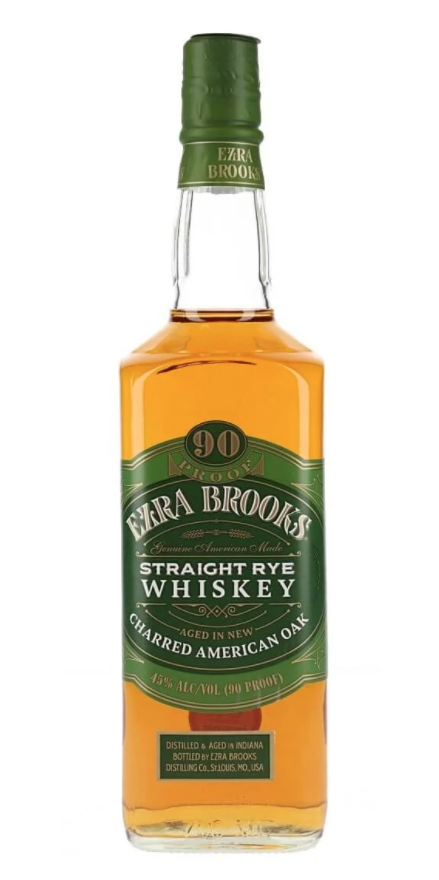
First up is a straight rye whiskey from Ezra Brooks, a brand owned by Luxco of St. Louis, Missouri, which, by the way, also owns the Rebel Bourbon brand [and is, in turn, been acquired by MGP of Indiana in 2021]. This whiskey is 51% rye, 45% corn, and 4% “magic juice”, which is often referred to as “malt” on the label. It’s bottled at 45% ABV, or as the Americans put it, 90 proof. The process of distilling all whiskey is very much the same – so it is mainly about all of the ingredients (see the mash bill recipe I just outlined above). In general, the rye is a bit spicier, sharper, and thinner, while the corn turns out sweeter, full-bodied and rounder. Also, rye is a ‘drier’ spirit and is something I personally prefer in my cocktail versus a sweeter bourbon. The ageing of both spirits must occur in new [aka “virgin”], charred [but not necessarily American] oak barrels, at no more than 125 proof. So what then makes it “straight” whiskey? The regulation specifies that it must be aged for at least two years, not blended with any other spirits, and have no other additives except water [that’s right, no colouring either], to make it a “straight whiskey”. So if you read between the lines, that means that any other American whiskey which isn’t labelled “straight” could be as young as “zero” days [literally], with other things, including maple char “filtration” before the distil goes into the barrel – which then would make it a Tennessee whiskey, using Lincoln Country Process [like Jack Daniel’s].

It’s the same with bourbon, which must be made of at least 51% corn, distilled at no higher than 160, barreled at no higher than 125, and bottled at no less than 80 proof. And again, just as straight rye, it must be aged for a minimum of two years in new charred oak barrels. So as I said before, the difference between these two bottles is in the mash ingredients and the final proof. Besides the corn, Rebel 100 is also made with wheat, which is an even lighter grain distillate. Although I sipped on straight rye from the glass, I added a bit of water to the 50% ABV bourbon to have it open up, and then the caramel and the vanilla came to the forefront of the nose. Whereas the straight rye maintained a bit of oakiness in the finish, the straight bourbon left my taste buds with a hint of honey. Both of the spirits felt a little young – I’m really spoiled by the older single malts – and as a result, have really punched through in a sweetened cocktail. In my case, the rye has really seized the Sazerac [with a bit of lemon peel slapped around the nose of the glass], while the bourbon turned my Old Fashioned nice and silky. Cocktails could be a bit dangerous, though, since, with the sugar, you will really hide the alcohol potency and then possibly gain a headache in the morning [thankfully, I was careful this time].
In summary, I have enjoyed both of these “straights” very much here, although, again, they don’t stand up against my personal selection of well-aged whiskies. The Ezra Brooks goes for only about £30 a bottle, while the Rebel 100 adds another tenner to the bill. I think the latter’s extra 25% upcharge is worth it, and with that, I will proclaim that Rebel 100 wins this round.
[Update 7/30/2022] I’ve re-read this write-up and got a little confused myself on the definition of a “straight whiskey” – so let me try to clear it up again, as best as I can. You see, the fermented mash before it is distilled can be composed of various cereals to a particular ingredient recipe of a “grain bill” [or a “mash bill”]. A 51%+ of the content of a particular grain can then claim its name on the label. So a “rye” whiskey must have at least 51% of rye in its mash. Other ingredients can still be corn, barley, rice, oats, and who knows what. And this is different from, say, a 100% rye whiskey, where the mash bill had only rye in it. Then, it is distilled to no more than 80% ABV, aged in new charred oak barrels, and filled at no more than 62.5% ABV. If it’s aged for at least two years and further not blended with other spirits (unless it’s married with multiple barrels from the same batch [or even other batches from the same distillery, but not other spirits, you see?]), only then it could be called a straight whiskey. Yes, a bit complex, but is that easier to digest now?
 Two Drams A Day